
In many spiritual traditions, the idea of suffering is often seen as a gateway to liberation. In Sanskrit this is known as Duhkha: Pain, suffering, distress, disease. The awareness of suffering in the body and mind, or the onset of crisis is very often a necessary catalyst for change, ‘the crack that lets the light in’ – as Leonard Cohen once sang.
Ten years ago, in response to a sudden awareness of anxiety, overthinking, and unease in my body, I intuitively began trying to do yoga and meditation. Having always been a worried kid, the onset of my early twenties seemed to unleash a wave of unease in my body – a wave of suffering.
I was first introduced to yoga by my mum, who’s luckily a yoga teacher. Having taken a few classes without much interest in my teens, I did remember something about moving and breathing in a sequence known as a ‘Sun Salutation’. After a turbulent mental period, I began trying to do these movements I remembered in my room at college from a practice sheet a few times a week. I wasn’t really sure what I was doing, and half the time I was hungover, but something about moving and breathing in these repetitive, simple movements was strangely calming to my agitated mind.
It’s the Summer of 2014. I’m in my early twenties and I find myself on an art-school Summer trip to Berlin. I was spending a few weeks wandering around the city with friends, visiting art galleries, drinking, and generally messing around. I was recently heartbroken and I felt lost. Inside my body was experiencing some kind of recurring psychosomatic pain.
It was during this time that I would visit my first yoga shala, called Astanga Spirit in Kreuzberg. Early one morning I nervously enter a room full of people practicing. Everyone is moving at their own pace rather than being led by a teacher, they have memorized the sequence and move in complicated and graceful flows in a seeming trance of focus. There is an intimidating yet intoxicating atmosphere – the sound of everyone’s breath creates sounds like waves rising and falling against sand.
I stumble awkwardly through a sequence of postures the teacher gives me.
After leaving my first class, I remember the colors on the graffiti walls of Kreuzberg seemed brighter – a lightness had entered my body, and clarity and ease in my mind had miraculously taken hold. This was a different feeling to my previous experience of yoga – there was something deeper, an intense yet nourishing – almost shimmering feeling of tiredness and calm had washed over me.
The series of postures, movements, and breath techniques I would learn here would stay with me.
This intense, dynamic movement yoga practice is known as Ashtanga yoga and comes from Mysore, India. It became popular in the 70’s when Western travelers happened upon a shala and a teacher – Pattabhi Jois -and the transformative, therapeutic practice he was teaching.
The practice involves deep breathing known as Ujjayi breath, which opens up the body and calms the mind through a series of postures, known in Sanskrit as Asanas.
As you breathe, move, and focus your attention, a profound inner heat is generated. The synchronization of breath to movement is known as a Vinyasa, here, a space of healing forms, where old wounds, patterns, and toxins both physical and mental have the chance to leave the body.

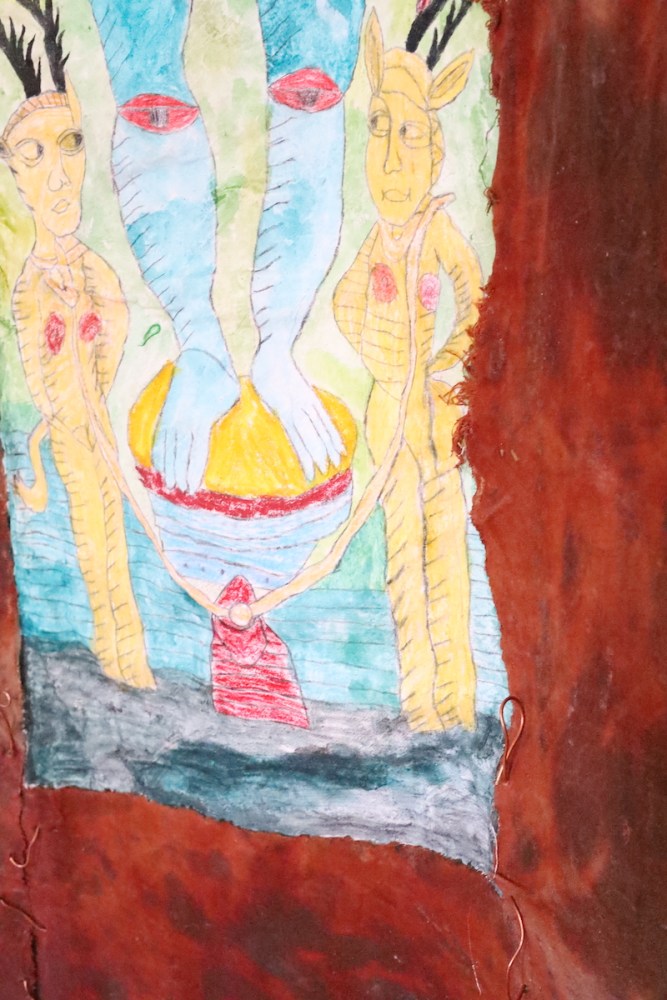
The Devil card of the Tarot de Marseilles speaks of a world of knots, animality, and suffering. A devil made of parts animal and human, with many faces, stands powerfully between two goblin-like creatures, bound by cords. With their tongue sticking out, the devil beckons us forward, making a strange symbol with their hand. In the other, they hold a staff with rabbit ears attached to the top.
Binds, dominance, and fear pervades the imagery. The two creatures seem to be enslaved by the dominant devil, with ropes around their necks, they seem submissive in their stance. The devil has a face on its belly and eyes on its knees – like an exotic bird in a mating ritual it produces a hypnotizing display.
Anonymous of Meditations on the Tarot writes about the card:
‘The fifteenth arcanum of the Tarot is that of the generation of and the enslaving of so-called “artificial demons” – It is a warning that we certainly have the force to generate demons but that the use of this force will render the generator a slave.’
Anonymous
In Anonymous’s reading, the demon of the Devil card has not enslaved the two creatures, but rather is created by the two creatures, by their ‘will and imagination that is perverse or contrary to life’ – The enslaved creatures’ excessive, perverse ‘will and imagination’ ie. thoughts and behaviors – has created the demon, which now rules them – in other words, they have enslaved themselves.
In this reading of the symbolism, the generation of demons can be read simply as a lesson on the dangers in the thinking mind of humans; the dangers of addiction, rumination, and overthinking, forces that run contrary to the healthy flow of life. The animalistic body of the demon tells us we are in a world of primal urges, fears, and desires – the depths of our being.
In the animal body of the subconscious are fears that have the potential to imprison and entrap our body toward coping mechanisms and addictive behaviors of different kinds. As Jessica Dore writes, this is understandable, and not to be condemned – managing the biological, social, or psychological feelings of suffering through whatever means available is a natural, and often self-preserving act.
But when we engage in addictive behaviors and overthinking to avoid feeling the ‘big feelings’ in the depths of our body – our deep fears have the potential to grow and inflate, creating engrained bodily and psychological patterns that maintain suffering.
‘we slip a chain around our own necks every time we make certain thoughts, feelings, or sensations bigger and more powerful than they actually are’
-Jessica Dore

Samskara
In yogic philosophy a Samskara is a subconscious imprint – It is the belief that every moment a trace is being left on our body; by all the words, experiences, and people that come into our awareness.
Like a web or a pool of water, our body is viscous, non-solid – more like a phenomena of activity than a solid object. When something falls into this phenomena of activity – like a traumatic experience or a hurtful word – it stays there, like a rock thrown into a lake. The heavier the rock, or the more traumatic, or repetitive the experience – the deeper the mark.
These imprints determine the course of our life and if not resolved, we will continue to return to these marks, like tracks in a forest path. As we return to old marks, we re-open the old wounds, making them deeper each time we trawl through.
In this way, the body is but ‘the crystallized history of our past thoughts, actions, and emotions ‘ as Greghor Maehle writes. The body and mind become hard and solidified over the years as the tracks of time and experience weave into the fabric of tissue, muscle, and bone.
In many yogic philosophies, it is believed that we carry not only Samskara scars of this life but also ones we have inherited from our past lives. It’s believed a deep Samksara scar, like an intense trauma, can be passed down multi-generations.
Our bodies are made from old material – flesh and fiber linked from body to body. Woven into our tissue may be unresolved suffering we have not lived through.
~
The Asana practice of Ashtanga Vinyasa was designed to release from the past conditioning of Samskara and arrive fully in the present moment.
Working directly with the physical body as a ground for therapeutic work. the practice involves the systematic folding, unfolding, tightening, releasing, inhaling, and exhaling of breath and body.
As the practitioner becomes immersed in a long practice, a profound vibration begins to ring through the body, the breath seems to permeate the fibers of tissue and muscle, and the blood feels like it pumps in new ways, opening locked currents of energy.
Life is a constantly changing set of phenomena and our bodies are no different. That which arises wishes to pass away. The binds of rumination, addiction, and stagnation keep our minds stuck on a track, crystallizing into a stubborn immovability, an unwillingness to feel the big feelings of life, to experience the changing currents of experience.
In the changing forms of the moving practice of Ashtanga Vinyasa Yoga there is the potential to enter into the oceanic flow of life, a flow of energy that can burst through blocked channels of energy, currents that can pierce through crystallized thought patterns.
‘The vinyasa practice is the constant coming and going of postures, the constant change of form, itself a meditation on impermanence.’
-Greghor Maehle
Becoming free from the entrapments of the body
Tapas in Sanskrit speaks of the purifying heat of disciplined spiritual practice. The practice of Ashtanga Yoga builds heat, a heat that if burned regularly, can banish demons from the entrapments of the body. The heat of the practice brings demons, be they physical or mental, to the surface where they can be seen, which is the first step toward banishing evil spirits.
‘Good does not combat evil in the sense of destructive action. It “Combats” it by the sole fact of its presence. Just as darkness gives way to the presence of light, so does evil give way before the presence of good.’
Anonymous
As Anonymous writes, the best way to become free of the darkness is simply to turn on the light. The process of unraveling the suffering of the body is lifelong and multi-generational and so the practice of yoga is a space that must be entered with regularity for its light to keep burning. A devoted spiritual practice, when done with the right intention, has the potential to burn a flame so bright that darkness simply cannot exist anymore. A heat hotter than the Devil’s flame.
~~~~~~~~~~~~~~~~~~~~~~~~~~~~~~~~~~~~~~~~~
Text by Jack O’Flynn
‘The Devil’ artwork was created by Jack O’Flynn and Bergen based multi-media artist and performer Clea Filippa.
Materials: Textile, pigment, pencil, gouache, copper wire. 2024.
Sources:
Anonymous Meditations on the Tarot TarcherPerigee. 1980
Jessica Dore Tarot for Change Hay House. 2021
Greghor Maehle Ashtanga Yoga: Practice and Philosophy 2007
 whenweseeyou.com