In my early 20s I discovered a book called The Wisdom of Insecurity by Alan Watts. Overhearing someone talking about it, I was immediately drawn to its perplexing title. What could be wise about insecurity? What did that even mean? At the time, I was in a threshold space, leaving behind my teenage years, about to walk into the unknown landscape of adulthood. It was one of those books that seems to appear from the ether, as if conjured from a past life which knows you will need it sometime. Fittingly, I was feeling insecure and anxious.
Insecurity, in this book, refers to the fear of the unknown; the human desire to control our future to ensure pleasure and security. The wisdom that Watts shares is that, in fact, the more we try to control our life – the more detached we will be from the experience of our life. The more we try to stop feeling anxious – the more we will feel enflamed with anxiety. In a memorable opening passage, Watts describes what he calls the ‘backwards law’ of life
‘I have always been fascinated by the law of reversed effort, sometimes I call it the ‘backwards law’; when you try to stay on the surface of the water, you sink, but when you try to sink, you float, when you hold your breath, you lose it…’
Alan Watts, The Wisdom of Insecurity
As I read these words, I felt as though I could hear a bell ringing in the distance – an alert, something I knew deep down but could not quite grasp in that moment. I was in a state of overthinking at the time, and these words – that pointed to the contrary nature of the universe – seemed to gently explain that whatever I thought was wrong with me, would get no better by ‘trying’ through more thinking. Somewhere deep down, I knew – my thoughts had created all my ‘problems’.
~
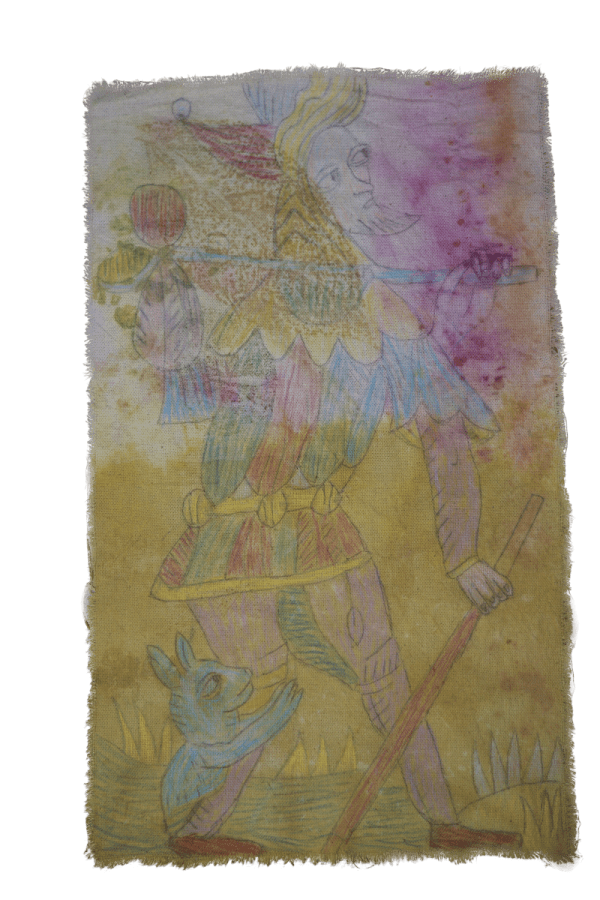
The call to movement, adventure, and spontaneity are often seen in the imagery of the Fool card. The Fool has no number but is usually thought to be the first card – a formless beginning.
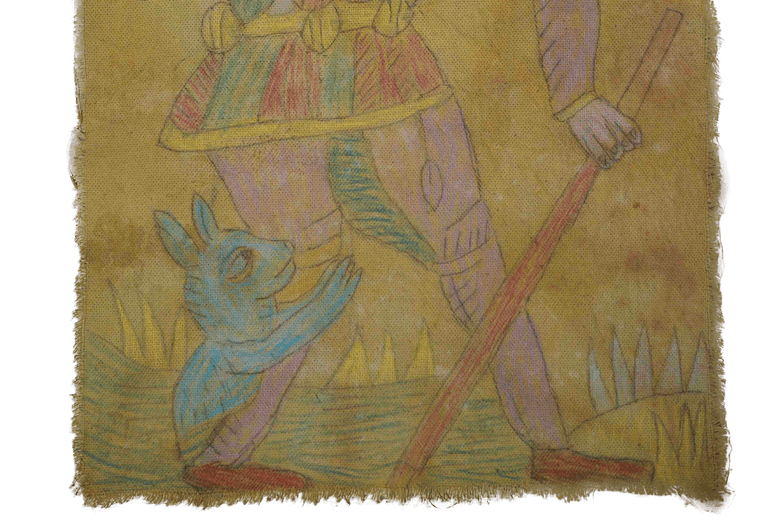
On first appearance, he seems a happy-go-lucky figure walking with a bag slung over his shoulder. A little blue dog is behind him – perhaps chasing him, perhaps sending him in the right direction. He is walking and carries his possessions with him over his shoulder – it could be said he is leaving and won’t be returning.
So this image marks a transition from one place to the next. Where is he going? What is he leaving?
He holds a powerful red walking stick that connects him to the ground, and looks to the empty sky above. He follows a wordless direction of no thought, trusting the ground beneath.
In the treatise on The Fool in Meditations on the Tarot by Anonymous, it is written that:
‘The Tarot Arcanum The Fool is related to the transformation of personal consciousness into cosmic consciousness where the self (ego) Is no longer the author of the act of consciousness but is its receiver ‘
Anonymous, Meditations on the Tarot
In this reading, The Fool walks away from a life of disconnection from the world where he believes he is separated from his environment, to one who begins to trust in the unknown unfolding before him. In each step toward a deepening connection to life, he walks away from the idea that he is a lone ego, unique in his suffering, into a world of reciprocal, cosmic co-creation.
‘There is no ‘I’ who is having an experience, there is just experience’
Alan Watts, The Wisdom of Insecurity
I walk into a windswept rainy morning, patches of blue and sunbeam breaking though cloud. I’m making my weekly pilgrimage up Fløyen, one of Bergen’s seven mountains. I’m thinking of the Fool and paying attention to each step before me. I take a detour through a less-walked mountain trail and find myself lying for a moment in a patch of fuzzy cold moss. I feel the ground beneath me and close my eyes. I think about the insecurity of our place in the world and the fragility of our sense of self. A dark world floating in the ether, swirling through a void of thought and feelings. I open my eyes to the sound of bird song, trees, and the swirling wind. For a moment, I think I feel what Alan Watts meant when he said there was no ‘I’, just experience – the birdsong is above me, but it’s also within me and it’s as much a part of me as any of my thoughts are.
The Fool packs his bags and chooses a life on the road, each moment being a new one. He leaves behind the old self – the yapping dog – of mental turmoil; the swirl of thoughts, tensions, and anxieties that cloud his perception of life. The Fool’s bag reminds us that we always have all we need to leave behind the old self – we just have to begin observing our life. The practice of meditation is simply to observe; the deeper we observe, the more we will detach from our suffering, and the more our anxiety will float away.
This is therefore the arcanum of the transformation of mental turmoil
Anonymous, Meditations on the Tarot
In Zen Buddhism, there is the concept of shoshin, translating as ‘beginner’s mind’. The meaning of beginner’s mind points us toward a consciousness we experienced before we were aware of ourselves – from our earliest experiences in the world. Our ‘original mind’ is a state of mind that is open, receptive, and without preconceptions. This mind, as Zen Teacher Shunryiu Suzuki writes, is ‘empty’ of dualistic ideas of self and other; the belief that I am a separate mind in a world I must control.
‘Our “original mind’ includes everything within itself. It is always rich and sufficient within itself… If your mind is empty, it is always ready for anything; it is open to anything. In the beginner’s mind there are many possibilities; in the experts there are few’
Shunryiu Suzuki, Zen Mind, Beginner’s Mind

~
To meditate is to deepen, it is to go to the heart of things
Anonymous, Meditations on the Tarot
When I look back at that time when Alan Watt’s teachings found their way to me, I realise I was beginning my own Fool’s journey – one that I must remember to return to constantly. Mental turmoil – the ego – is always lurking, ready to cloud life with its stories and narratives. The Fool is here to remind us that at any moment we can walk away from mental turmoil by trusting what is before us, by connecting to the ground beneath us, by opening to the world. We can begin anew every moment by coming back to our original nature: the beginner’s mind. The mind before we had a mind, which is always there – in the heart of things – ready to be received.
~~~~~~~~~~~~~~~~~~~~~~~~~~~~~~~
Artwork details:
The Fool, Le Mat
Jack O’Flynn & Ambra Grassi, Colouring pencil, pen, plant dye on natural fibre, 23.5x39CM, 2025
The Fool was created in Collaboration with Ambra Grassi. Ambra is an Italian transdisciplinary artist. She uses a wide range of techniques, including graphic art, painting, and installation, without favoring any particular one. This layered approach allows her to create new scenarios through which to explore the many manifestations of existence and a world in perpetual change. Her works are often connected to her travels and movements, referencing the cultural traditions of the places she visits, intertwining with the artist’s personal experiences and drawing from the coincidences, encounters, and emotions that animate them.
https://www.instagram.com/gipsyember/
Sources:
Anonymous, Meditations on the Tarot
Alan Watts, The Wisdom of Insecurity
Shunryiu Suzuki, Zen Mind, Beginner’s Mind
Alejandoro Jodorowski, The Way of Tarot: The Spiritual Teacher in the Cards
 whenweseeyou.com