Wands, Life & Death

I’m sitting in my secondary school car park, 17 years old and directionless. My girlfriend sits beside me, encouraging me to take an upcoming art college portfolio course our teacher will run after class. As she speaks, I am slowly sketching a tree in front of me. I follow its trunk to its unfurling branches. The tree has cracked through the school tarmac. I am making life-altering choices but I don’t know it. I use my pencil and scratch the tree’s branches to the sky above.

~

13 years later and I find myself on an art residency nestled along the west coast of Norway. I’m working here for several months in a wood cabin with a studio. Perched atop a valley, surrounded by mountain peaks and fjords. It’s the beginning of April, still a cold month here. Although the trees show no signs of green – somewhere beneath the surface is a humming force; the blooming of spring about to burst through the branches, beneath the roots.

From my cabin, the sound of a stream running can be heard, absorbed into a hum of cars, an occasional industrial hammering, birdsong, and the baaa-ing of sheep. Swirling winds and cascades of rain fall on the wood roof. I’m beginning a new body of work and I don’t know where to start. Instinctively, I begin to draw what I can see from my window; branches, roots, foliage, trees and the blossoming leaves.

~

The wands, or baton element of the Tarot symbolize all that grows and spreads, what is built through inspiration, creativity, and passion. They appear as branches with leaves growing from them, or powerful sticks to hit someone with. They speak of the forces of nature, the self-propelling turbine of momentum that generates energy in the world. They are about using our energy to build something, like a work of art, like this wood-house I’m staying in, like a ship or a tower.

A tree must use force to penetrate through the soil and claim its space in the environment. From the immense potential of a tiny seed that holds the blueprint of its design, branches and roots move instinctively toward space and nutrition. A tree has inherent creative potential, the power to claim space in the world, to change its environment, and to build something.

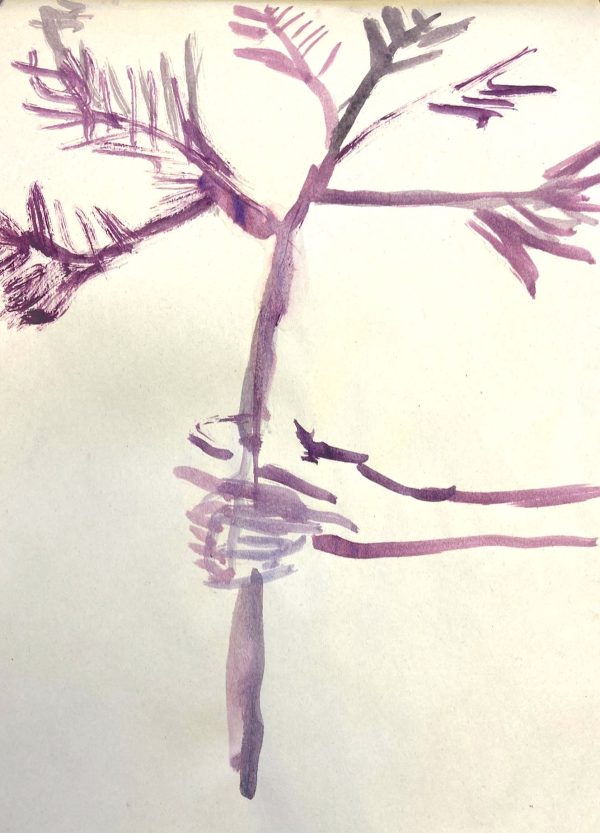
In the Ace of Batons of the Tarot Marseille, a lone hand holds a cut branch. The branch is growing fast, upwards with force. It seems both phallic and vaginal: the power to inseminate and birth, to create something is to birth something, to fuck it into existence.
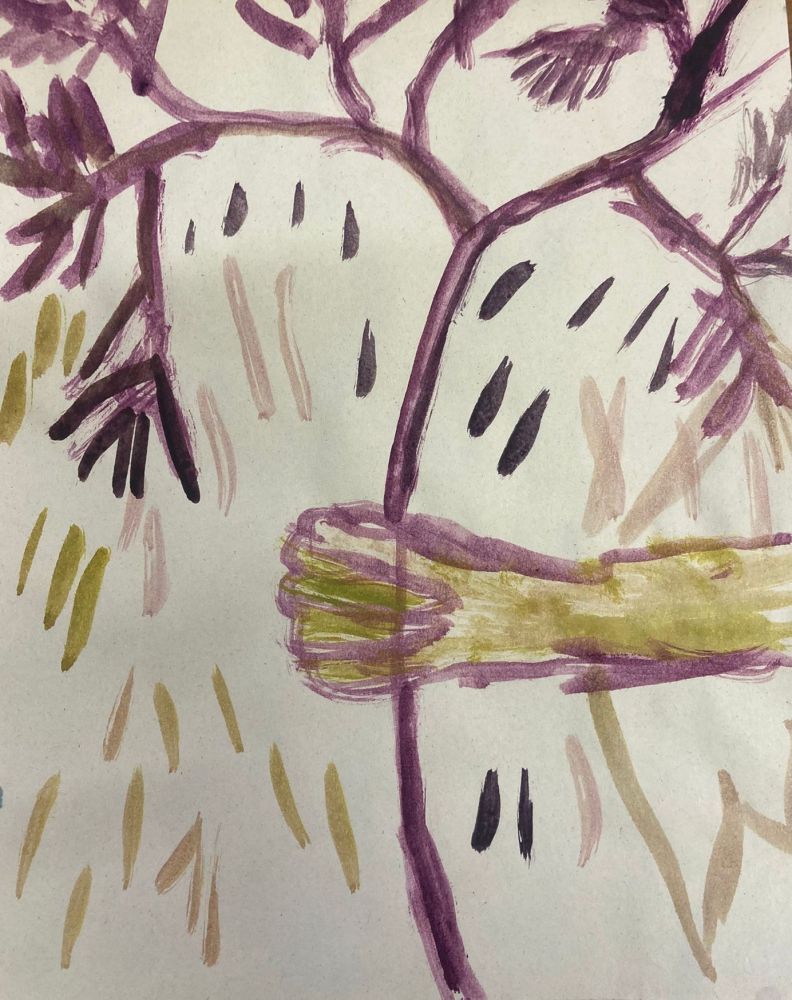
The Ace of Wands no.IV, Watercolour on newsprint,
8.27 x 11.69 inches, Jack O’Flynn 2025

~

In my wood cabin I wake early and light the fire, drawing a few trees from my window over a cup of tea before meandering down to the studio.

Making a work of art is like growing a plant or starting a fire . When you start, you have to be very gentle, working slowly, finding a little spark here, a little growth there. Blow too hard or pour too much water and you’ll kill your creation before it’s ready. But if you make the conditions right, slowly adding more material, more time, more air, a creative fire will start to spread.

The fire heats the cabin, which creaks and groans in response. Trees become fuel and fire generates heat. Heat is vitality spreading through the air. Wands also speak of the vitality of the body and encourage a firey relationship to the world around us, one that grows and expands and creates.

~

Growth needs to feed, and the dead leaves of the previous year fertilise the soil for the tree’s new growth. To make a work of art, I have to fail, I have to discard what doesn’t work. But what I throw away, what dies, will come back as the right form if I keep failing, if, as Samuel Beckett said, I can fail better.

I want my studio to become like a blooming wild garden, where all the plants are pushing each other to grow, where the destruction and failure of one work becomes the material for a new growth, where a fire can ravage everything in its path but leave only what is too strong to fall.

~

The rain falls heavy on the wooden house. Inside, the fire keeps the air warm. It’s dark and windy. After several days of uneventful drawing, I suddenly feel this shimmery butterfly feeling of excitement, the feeling that something new is about to happen, the feeling of a sudden reservoir of potential opening up.

Potential is that feeling you get just before jumping from the rock, when your body is about to hit the cold water and you feel every fiber of your body go alive. The energy preluding materiality, preluding creation, making the process happen. If I’m present with the energy, I’ll feel it breathe, breathing like a tree.

~

From seed to sprout, seedling to sapling, a tree grows old like a human, reaching maturity before slipping into old age, finally succumbing to the ground, rotting and crumbling to the forest floor.

It’s spring and it’s a great season of change and birth, of rapid flowering, colour and spreading. My studio too becomes sprawling and cluttered with different forms and materials. Clay and plaster sculptures start to combine with paint and texture, dust covers the floor and drawings line the walls. I wake early and feel lost in it.

The Ace of Wands no.III, Watercolour on newsprint,
8.27 x 11.69 inches, Jack O’Flynn 2025

~

After some months I collect the ashes from the wood-burning stove and pour them over some clay before putting them into the ceramic kiln at 1200 degrees. The minerals from the ash will burn into the clay, burning bright red, silver, then black and lime green like oxidised coral, speckled volcanic rock. I hold the clay sculpture in my hand, now emblazoned with the minerals from the ash of the trees I have burned to warm my cabin.

~

My time here is about to end. I take one of my last long meditative walks through the forest, getting a little lost in the old woods. I see fallen trees crumbling into the ground. The moss grows from the ground like a blanket and works its way up tendrils over the bark of the trees. I see big semi-circle flying saucer-like mushrooms growing from the trees. What are these portents? What is their intention? The forest appears in different stages of burst and crumble. The moss blankets the floor and muffles the sound, as if to say – your words are no good here, this is something you won’t understand.

Mark Fisher defines the eerie as those experiences in life whose atmospheres are created by processes whose agency remains hidden from us, like time decaying an abandoned house, the slow rotting of a fallen tree sinking into the ground.

Walking through an old forest feels eerie. Maybe because somewhere in me I know there is death here, I know there are forces and processes at work that are frightening – forces that are also within me. I turn to face the forest, I hear a stick break and suddenly turn to see only trees. Silent and totemic. I feel I’m being watched.

A tree reaches for the sky, and crumbles into the black earth. Everything comes crumbling down, everything collapses. But everything comes together again, turning to fragment and dust, re-growing and sowing together as something new again. Something we don’t recognise anymore.

~~~~~~~~~~~~~~~~~~~~~~~~~~~~~~~~~~~~~~~

Jack O’Flynn, 2025

Drawings by Jack O’Flynn

Watercolour on newsprint, 8.27 x 11.69 inches

~
The Fool and the Wisdom of Insecurity

In my early 20s I discovered a book called The Wisdom of Insecurity by Alan Watts. Overhearing someone talking about it, I was immediately drawn to its perplexing title. What could be wise about insecurity? What did that even mean? At the time, I was in a threshold space, leaving behind my teenage years, about to walk into the unknown landscape of adulthood. It was one of those books that seems to appear from the ether, as if conjured from a past life which knows you will need it sometime. Fittingly, I was feeling insecure and anxious. 

Insecurity, in this book, refers to the fear of the unknown; the human desire to control our future to ensure pleasure and security. The wisdom that Watts shares is that, in fact, the more we try to control our life – the more detached we will be from the experience of our life. The more we try to stop feeling anxious – the more we will feel enflamed with anxiety. In a memorable opening passage, Watts describes what he calls the ‘backwards law’ of life 

‘I have always been fascinated by the law of reversed effort, sometimes I call it the ‘backwards law’; when you try to stay on the surface of the water, you sink, but when you try to sink, you float, when you hold your breath, you lose it…’

Alan Watts, The Wisdom of Insecurity

As I read these words, I felt as though I could hear a bell ringing in the distance – an alert, something I knew deep down but could not quite grasp in that moment. I was in a state of overthinking at the time, and these words – that pointed to the contrary nature of the universe – seemed to gently explain that whatever I thought was wrong with me, would get no better by ‘trying’ through more thinking. Somewhere deep down, I knew – my thoughts had created all my ‘problems’.

~

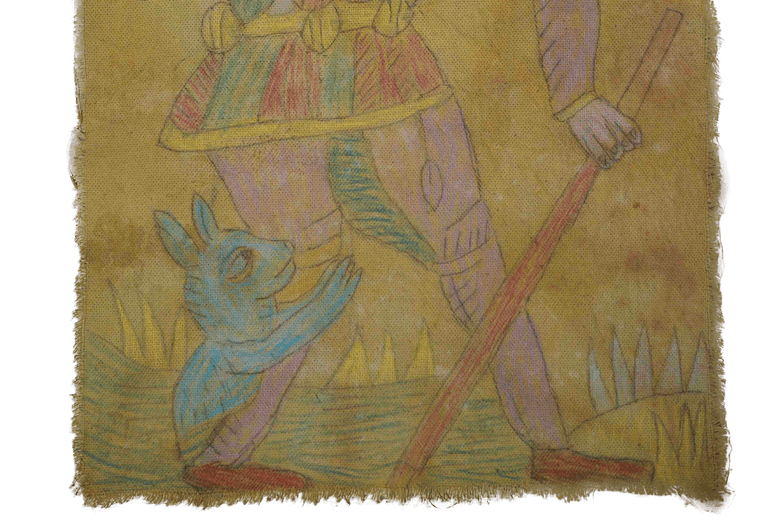
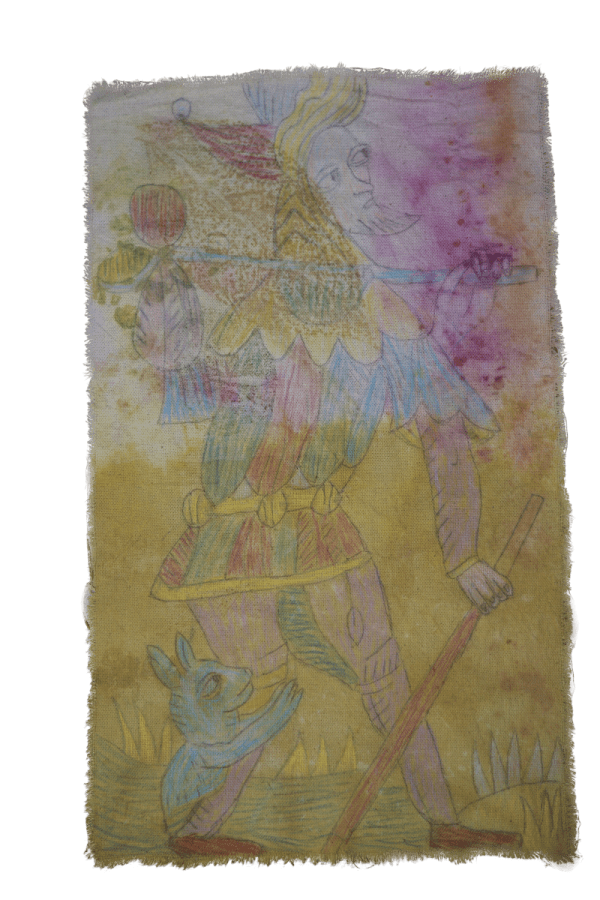
The call to movement, adventure, and spontaneity are often seen in the imagery of the Fool card. The Fool has no number but is usually thought to be the first card – a formless beginning. 

On first appearance, he seems a happy-go-lucky figure walking with a bag slung over his shoulder. A little blue dog is behind him – perhaps chasing him, perhaps sending him in the right direction. He is walking and carries his possessions with him over his shoulder – it could be said he is leaving and won’t be returning.

So this image marks a transition from one place to the next. Where is he going? What is he leaving?

He holds a powerful red walking stick that connects him to the ground, and looks to the empty sky above. He follows a wordless direction of no thought, trusting the ground beneath.  

In the treatise on The Fool in Meditations on the Tarot by Anonymous, it is written that: 

 ‘The Tarot Arcanum The Fool is related to the transformation of personal consciousness into cosmic consciousness where the self (ego) Is no longer the author of the act of consciousness but is its receiver

Anonymous, Meditations on the Tarot

In this reading, The Fool walks away from a life of disconnection from the world where he believes he is separated from his environment, to one who begins to trust in the unknown unfolding before him. In each step toward a deepening connection to life, he walks away from the idea that he is a lone ego, unique in his suffering, into a world of reciprocal, cosmic co-creation.

‘There is no ‘I’ who is having an experience, there is just experience’

Alan Watts, The Wisdom of Insecurity

I walk into a windswept rainy morning, patches of blue and sunbeam breaking though cloud. I’m making my weekly pilgrimage up Fløyen, one of Bergen’s seven mountains. I’m thinking of the Fool and paying attention to each step before me. I take a detour through a less-walked mountain trail and find myself lying for a moment in a patch of fuzzy cold moss. I feel the ground beneath me and close my eyes. I think about the insecurity of our place in the world and the fragility of our sense of self. A dark world floating in the ether, swirling through a void of thought and feelings. I open my eyes to the sound of bird song, trees, and the swirling wind. For a moment, I think I feel what Alan Watts meant when he said there was no ‘I’, just experience – the birdsong is above me, but it’s also within me and it’s as much a part of me as any of my thoughts are.

The Fool packs his bags and chooses a life on the road, each moment being a new one. He leaves behind the old self – the yapping dog – of mental turmoil; the swirl of thoughts, tensions, and anxieties that cloud his perception of life. The Fool’s bag reminds us that we always have all we need to leave behind the old self – we just have to begin observing our life. The practice of meditation is simply to observe; the deeper we observe, the more we will detach from our suffering, and the more our anxiety will float away.

This is therefore the arcanum of the transformation of mental turmoil

Anonymous, Meditations on the Tarot

In Zen Buddhism, there is the concept of shoshin, translating as ‘beginner’s mind’. The meaning of beginner’s mind points us toward a consciousness we experienced before we were aware of ourselves – from our earliest experiences in the world. Our ‘original mind’ is a state of mind that is open, receptive, and without preconceptions. This mind, as Zen Teacher Shunryiu Suzuki writes, is ‘empty’ of dualistic ideas of self and other; the belief that I am a separate mind in a world I must control.

‘Our “original mind’ includes everything within itself. It is always rich and sufficient within itself… If your mind is empty, it is always ready for anything; it is open to anything. In the beginner’s mind there are many possibilities; in the experts there are few’

Shunryiu Suzuki, Zen Mind, Beginner’s Mind

~

To meditate is to deepen, it is to go to the heart of things

Anonymous, Meditations on the Tarot

When I look back at that time when Alan Watt’s teachings found their way to me, I realise I was beginning my own Fool’s journey – one that I must remember to return to constantly. Mental turmoil – the ego – is always lurking, ready to cloud life with its stories and narratives. The Fool is here to remind us that at any moment we can walk away from mental turmoil by trusting what is before us, by connecting to the ground beneath us, by opening to the world. We can begin anew every moment by coming back to our original nature: the beginner’s mind. The mind before we had a mind, which is always there – in the heart of things – ready to be received.

~~~~~~~~~~~~~~~~~~~~~~~~~~~~~~~

Artwork details:

The Fool, Le Mat

Jack O’Flynn & Ambra Grassi, Colouring pencil, pen, plant dye on natural fibre, 23.5x39CM, 2025

The Fool was created in Collaboration with Ambra Grassi. Ambra is an Italian transdisciplinary artist. She uses a wide range of techniques, including graphic art, painting, and installation, without favoring any particular one. This layered approach allows her to create new scenarios through which to explore the many manifestations of existence and a world in perpetual change. Her works are often connected to her travels and movements, referencing the cultural traditions of the places she visits, intertwining with the artist’s personal experiences and drawing from the coincidences, encounters, and emotions that animate them. 

https://www.instagram.com/gipsyember/

Sources:

Anonymous, Meditations on the Tarot

Alan Watts, The Wisdom of Insecurity

Shunryiu Suzuki, Zen Mind, Beginner’s Mind

Alejandoro Jodorowski, The Way of Tarot: The Spiritual Teacher in the Cards

A Reflection On When We See You

Six months ago I was invited to Torino, Italy, to take part in a project called Luck Upside Down/Quando La Fortuna É Capolavolta at Studio Abra. I was asked to show some of the cards that were made for When We See You, as part of a larger project that featured a group exhibition and a lively programme of workshops and talks, curated by Marta Montoni and Paolo Volpe.

I spent two weeks wandering Torino feeling spellbound by the city of the Devil, as it’s known. Torino is one of the world capitals of the occult and once home to Italy’s royal family. It’s a city of decaying beauty surrounded by silver blue mountains and punctuated by an impossibly rising star -ascending from the Mole Antonelliana building housing the National Cinema Museum. 

The exhibition opened on the night of a lunar eclipse. In Vedic astrology, solar and lunar eclipses are seen to symbolise the opening of a dragon’s mouth and the whiplash of its tail. The dragon’s mouth, Rahu, opens a portal with a solar eclipse while Ketu, the dragon’s tail, closes it with a lunar eclipse. Potent signs of change, destruction, beginning and ending abound in times of eclipses. 

This time in the world feels increasingly volatile. Beyond the horizon of the silver blue mountains there is violence and suffering. I hear an aid worker on my Instagram story describe an ‘avalanche of suffering’ descending from the Israeli bombing of Gaza. When Israel suffered a surprise attack from Hamas on the borders of the city several weeks before, there was a warning that the Israeli response would be disproportionate – but the ferocity of the bombing seems to have shocked even seasoned analysts. Outside my apartment, I see the words ‘PALESTINA LIBERA’ scrawled in big letters with spray paint.

Luck Upside Down/Quando la fortuna é Capolavolta, Installation shot, Studio Abra, Torino, 2023

I started When We See You in 2021 in Glasgow, in the midst of a third national lockdown due to the global pandemic of Covid-19. I had been learning about Tarot cards since 2019 but the space and boredom of lockdown encouraged a deeper connection to the cards. I began pulling cards and writing advice from them to myself daily and some of these texts became blog posts. I wanted to draw the images to understand them better, in particular the Tarot de Marseille deck, and I found drawing brought a more intimate, embodied understanding of these mysterious images. 

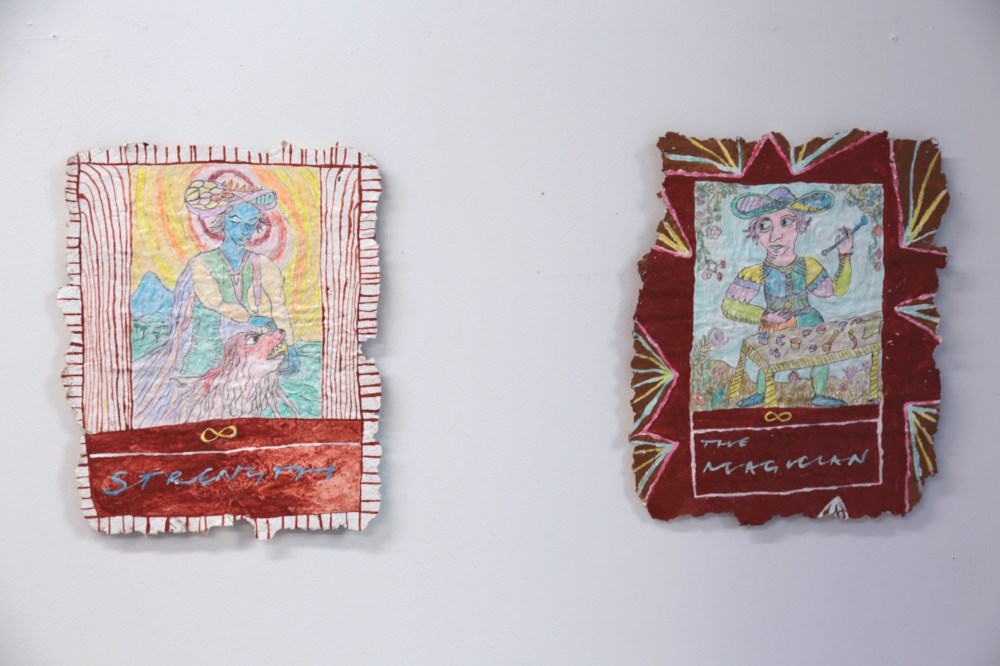
The decision to make art about the cards with collaborators came spontaneously. I remember seeing some handmade paper that Connie Hurley, soon to be my first collaborator, had made on Instagram. She had drawn a border around the middle and marked the uneven edges, leaving an empty blank space. I thought they seemed like little cards waiting to be filled in. We met over Zoom and I asked her if she could make some more paper and interpret the borders leaving a space in the middle. We pulled three cards together: The Chariot, Strength, and The Magician. We created the cards over post, with handmade paper and colouring pencils – soft edges and uneven borders. 

Strength & The Magican by Jack O’Flynn and Connie Hurley, pencil, paint, handmade paper. 20x30CM, 2021

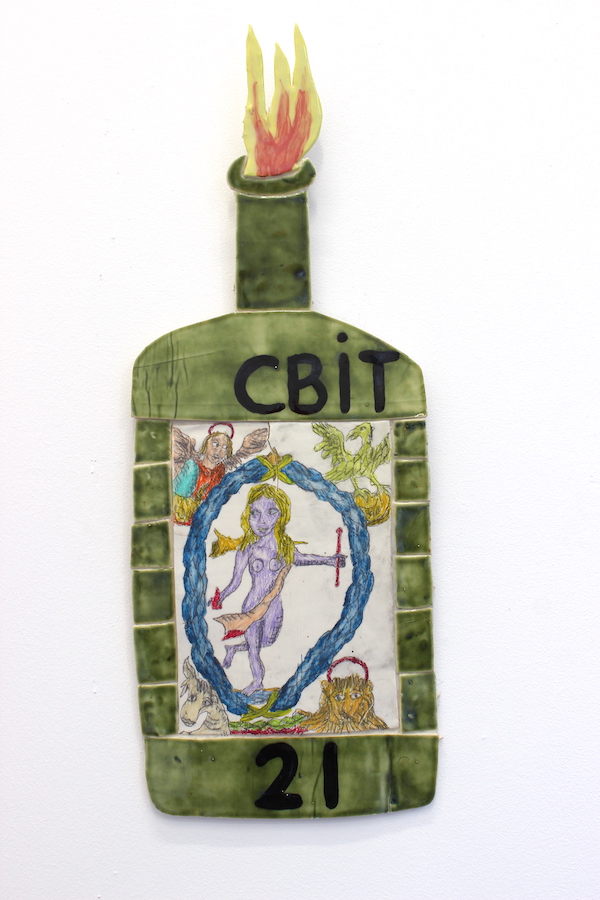
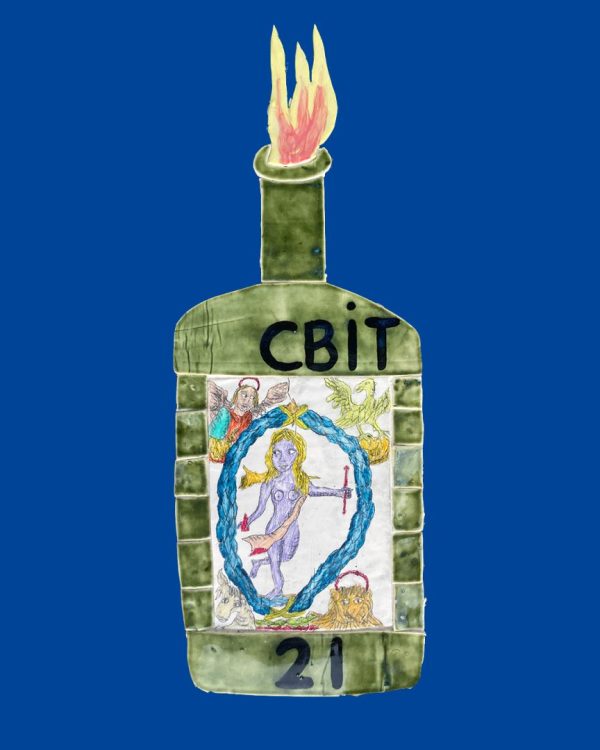
Working in another’s material and idea allowed for unexpected juxtapositions. At the opening in Torino a woman asks to speak to me. She is Ukrainian and sees that the ‘World’ card, made with Lisa Rytterlund, has the Ukrainian word for ‘World’ – світ – is inscribed on the card. The card was made in ceramic by Lisa, in the image of a Molotov cocktail.

In spring of 2022, the Russian invasion of Ukraine had began, and Lisa wanted to acknowledge the precarious state of the world when we re-created a card about the ‘World’. The Ukrainian woman tells me she assists the army in radar detection, and that she is on a break in Torino visiting friends. After interrogating our motivations a little, she tells me seeing the word for world in her Ukrainian language as she entered the exhibition was an unexpected emotional surprise, that it made her feel seen and connected to the art – she thanked us for thinking of Ukraine.

‘The World’ Jack O’Flynn and Lisa Rytterlund, pencil on glazed ceramic, 30x80CM, 2022

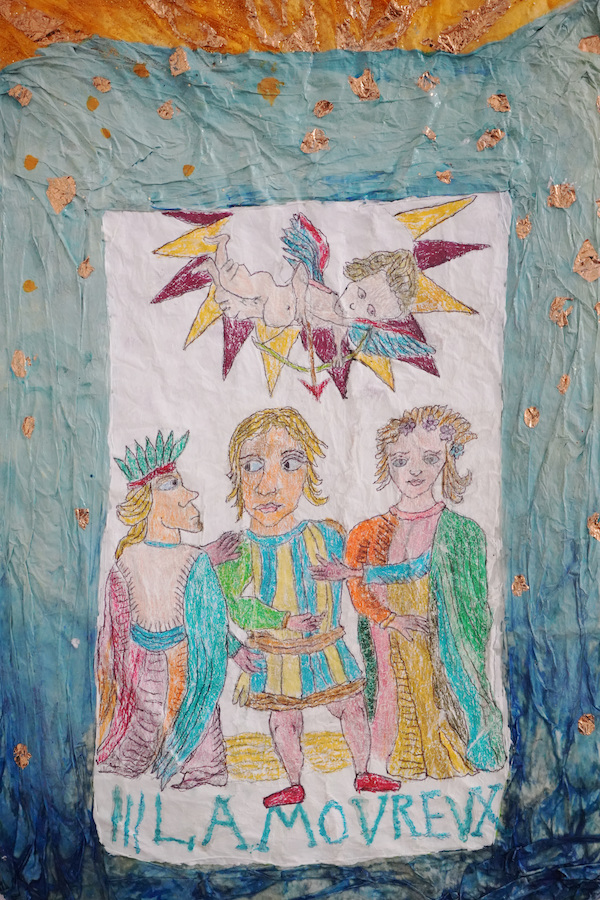
Art communicates in mysterious ways and its effect can not be controlled. In the Summer of 2021 I made the Lovers and Tower card with Tamara Macarthur. I made the cards around the time of a powerful eclipse in Gemini, and met Ruby, who within six months would leave Glasgow and move to Norway with me. You could say the Lovers and Tower together could be a portent for a life-changing relationship. I found drawing cards and turning them into an artwork has a strangely affective quality to my life, like the essence of the cards begins to generate a new reality. Anyway, since making those cards with Tamara nothing has been the same since.

I find myself within another eclipse portal. I’m feeling reflective of this project and of beginnings and changes and endings. Leaving my Masters course last year, the last work of art I made was the Moon card with Clea Fillipa. My time was ending in school, and I was feeling misty and tired. I had been drawn to Clea’s practice since arriving in Bergen for its watery and metallic materiality -as well as a kind of alchemical elemental quality. 

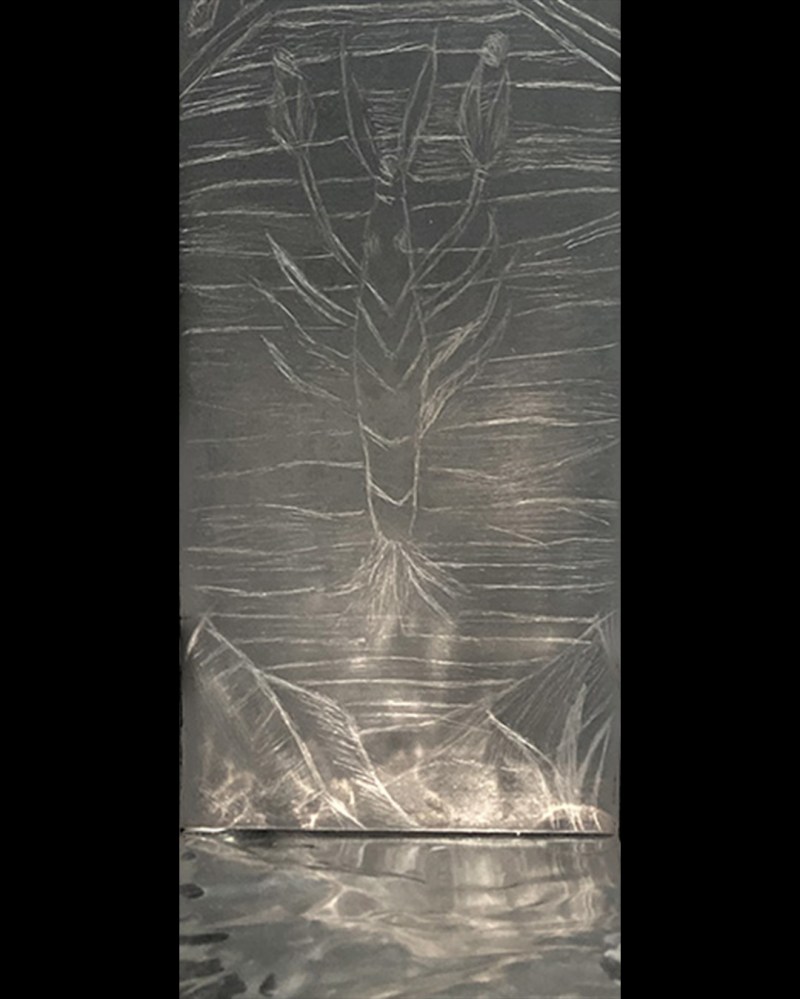
Clea offers The Moon card to be drawn on a silver steel plate, with an aluminum sheet seeming to reflect water. I scratched into the resistant plate for 3 days – finding the image in the darkness of the metal. In my own life it feels like I’m entering a world of darkness and uncertainty after a period of study and stability – the card is my entry point and the Moon becomes my guide for navigating the unknown. 

‘The Moon I’ Jack O’Flynn and Clea Fillipa. Scratched steel and aluminum. 25x70CM. 2023

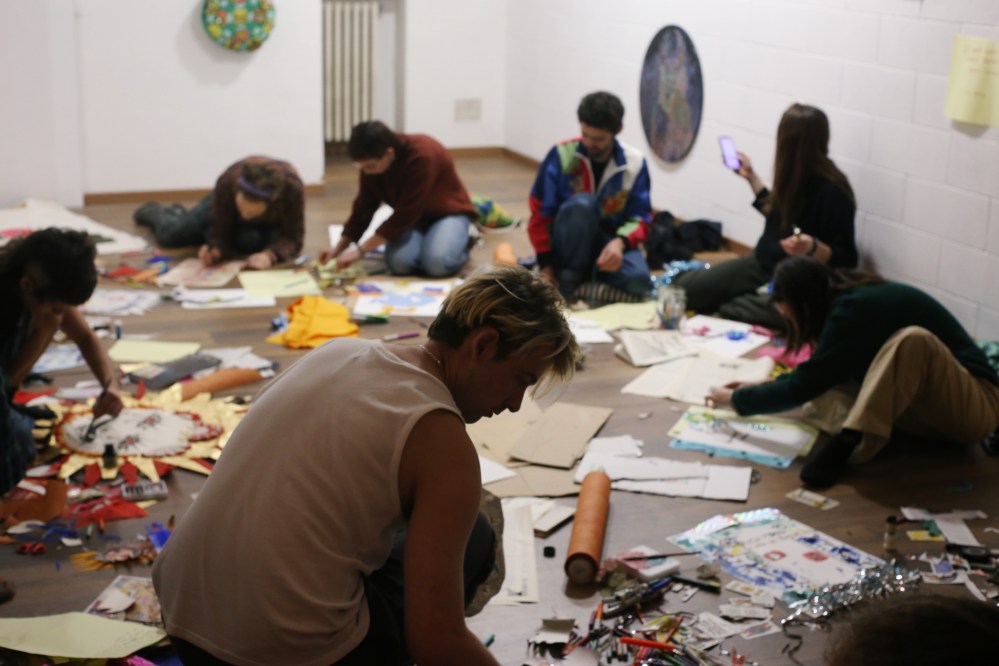
In Torino I’m encouraged by my hosts to run a workshop where we can make cards together, by way of introducing the project. Rachele and Marta take me to a scrap yard where we haggle for different materials, we find cardboard sheets, gold stars, playing cards, buttons and forgotten toys. 

Back at the workshop I pull cards for groups of two – a Major Arcana card for each pair. They are encouraged to write what they see before making a card together, drawing or collaging in any way they like, filling in one half, and handing it over to their partner. It’s chaotic and silly but everyone focuses on making their cards, choosing what imagery to pay attention to, and how to leave space for their partner. After several hours we have a motley crew of stars, horses, magicians, and towers. 

Card made for When We See You workshop by Marta Montoni and Ruby Eleftheriotis. 2023

After three years working with the cards in this way, it feels like it might be time to transition. I’m not sure if this is the end of When We See You, but maybe it’s a pause to the project. Unsure, I throw the IChing and ask for guidance – if it’s time to end the project. I get hexagram number 58, The Joyous, Lake. It shows two mirroring symbols, seeming to be two lakes reflecting one another. 

As cards and hexagrams are want to do – it doesn’t really give me a direct answer about what to do. Perhaps the lake reflecting back what it sees speaks to a harmonious sense of completion, of fullness. Perhaps it’s speaking to the nature of the project, of reflection, of seeing another in a card. One passage from the commentary jumps out at me; 

Knowledge should be a refreshing and vitalzing force. It becomes so only through stimulating contact with congenial friends with whom one holds discussions and practices application of the truths of life. In this way learning becomes many-sided and takes on a cheerful lightness whereas there is always something ponderous and one sided to the self taught. 

Why do we draw something? Why do we share it with others? One reason might be because we want to understand something and communicate it. Collaboration brings this communication to places that alone, we would not be able to reach and that in the end, would not be as fulfilling. And maybe trying to understand something is to pay attention to something, and paying attention is really caring about something. Paying attention to each other and the world around us, maybe that’s why we make art? 

When We See You workshop, Studio Abra, Torino, 2023

We leave Torino early one morning and fly over the silver blue mountains. I leave and I know my time here has changed me. A star reaches for the sky suspended as high as it will go. The dragon’s mouth opens and its tail brings down another tower. The effort to order the world, our lives and our art-projects is bound to fail -when one thing ends another begins. All we have is each other; affection and relation in the spiral of ceaseless change.

The Devil, suffering and Ashtanga Yoga

In many spiritual traditions, the idea of suffering is often seen as a gateway to liberation. In Sanskrit this is known as Duhkha: Pain, suffering, distress, disease. The awareness of suffering in the body and mind, or the onset of crisis is very often a necessary catalyst for change, ‘the crack that lets the light in’ – as Leonard Cohen once sang.

Ten years ago, in response to a sudden awareness of anxiety, overthinking, and unease in my body, I intuitively began trying to do yoga and meditation. Having always been a worried kid, the onset of my early twenties seemed to unleash a wave of unease in my body – a wave of suffering.

I was first introduced to yoga by my mum, who’s luckily a yoga teacher. Having taken a few classes without much interest in my teens, I did remember something about moving and breathing in a sequence known as a ‘Sun Salutation’. After a turbulent mental period, I began trying to do these movements I remembered in my room at college from a practice sheet a few times a week. I wasn’t really sure what I was doing, and half the time I was hungover, but something about moving and breathing in these repetitive, simple movements was strangely calming to my agitated mind.

It’s the Summer of 2014. I’m in my early twenties and I find myself on an art-school Summer trip to Berlin. I was spending a few weeks wandering around the city with friends, visiting art galleries, drinking, and generally messing around. I was recently heartbroken and I felt lost. Inside my body was experiencing some kind of recurring psychosomatic pain.

It was during this time that I would visit my first yoga shala, called Astanga Spirit in Kreuzberg. Early one morning I nervously enter a room full of people practicing. Everyone is moving at their own pace rather than being led by a teacher, they have memorized the sequence and move in complicated and graceful flows in a seeming trance of focus. There is an intimidating yet intoxicating atmosphere – the sound of everyone’s breath creates sounds like waves rising and falling against sand.

I stumble awkwardly through a sequence of postures the teacher gives me.

After leaving my first class, I remember the colors on the graffiti walls of Kreuzberg seemed brighter – a lightness had entered my body, and clarity and ease in my mind had miraculously taken hold. This was a different feeling to my previous experience of yoga – there was something deeper, an intense yet nourishing – almost shimmering feeling of tiredness and calm had washed over me.

The series of postures, movements, and breath techniques I would learn here would stay with me.

This intense, dynamic movement yoga practice is known as Ashtanga yoga and comes from Mysore, India. It became popular in the 70’s when Western travelers happened upon a shala and a teacher – Pattabhi Jois -and the transformative, therapeutic practice he was teaching.

The practice involves deep breathing known as Ujjayi breath, which opens up the body and calms the mind through a series of postures, known in Sanskrit as Asanas

As you breathe, move, and focus your attention, a profound inner heat is generated. The synchronization of breath to movement is known as a Vinyasa, here, a space of healing forms, where old wounds, patterns, and toxins both physical and mental have the chance to leave the body. 

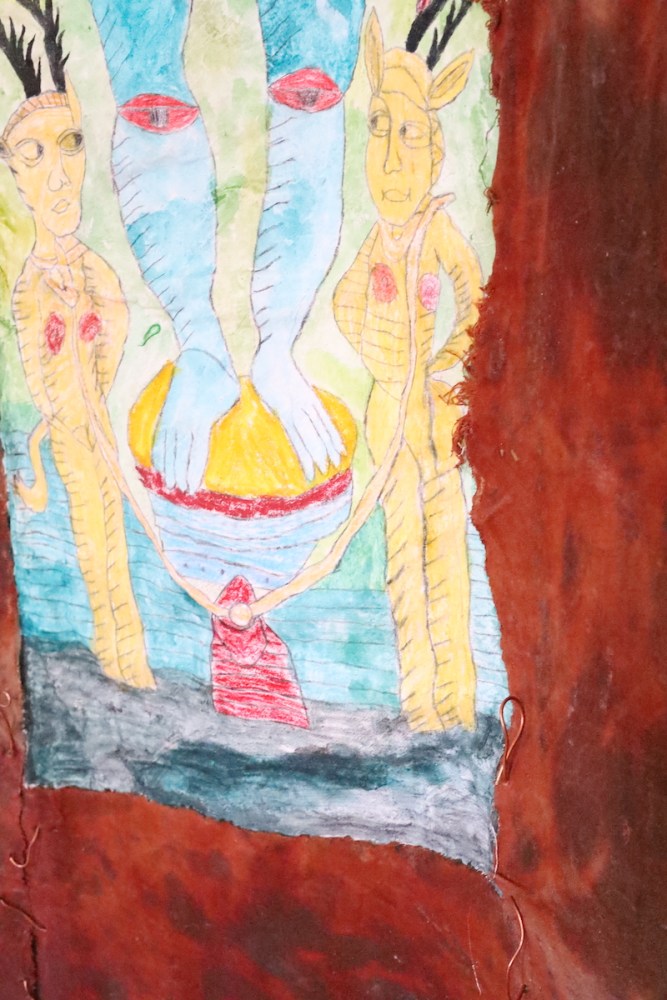
The Devil card of the Tarot de Marseilles speaks of a world of knots, animality, and suffering.  A devil made of parts animal and human, with many faces, stands powerfully between two goblin-like creatures, bound by cords. With their tongue sticking out, the devil beckons us forward, making a strange symbol with their hand. In the other, they hold a staff with rabbit ears attached to the top. 

Binds, dominance, and fear pervades the imagery. The two creatures seem to be enslaved by the dominant devil, with ropes around their necks, they seem submissive in their stance. The devil has a face on its belly and eyes on its knees – like an exotic bird in a mating ritual it produces a hypnotizing display.

Anonymous of Meditations on the Tarot writes about the card: 

‘The fifteenth arcanum of the Tarot is that of the generation of and the enslaving of so-called “artificial demons” – It is a warning that we certainly have the force to generate demons but that the use of this force will render the generator a slave.’

Anonymous

In Anonymous’s reading, the demon of the Devil card has not enslaved the two creatures, but rather is created by the two creatures, by their ‘will and imagination that is perverse or contrary to life’ – The enslaved creatures’ excessive, perverse ‘will and imagination’ ie. thoughts and behaviors – has created the demon, which now rules them – in other words, they have enslaved themselves.

In this reading of the symbolism, the generation of demons can be read simply as a lesson on the dangers in the thinking mind of humans; the dangers of addiction, rumination, and overthinking, forces that run contrary to the healthy flow of life. The animalistic body of the demon tells us we are in a world of primal urges, fears, and desires – the depths of our being.

In the animal body of the subconscious are fears that have the potential to imprison and entrap our body toward coping mechanisms and addictive behaviors of different kinds. As Jessica Dore writes, this is understandable, and not to be condemned – managing the biological, social, or psychological feelings of suffering through whatever means available is a natural, and often self-preserving act.

But when we engage in addictive behaviors and overthinking to avoid feeling the ‘big feelings’ in the depths of our body – our deep fears have the potential to grow and inflate, creating engrained bodily and psychological patterns that maintain suffering.

‘we slip a chain around our own necks every time we make certain thoughts, feelings, or sensations bigger and more powerful than they actually are’

-Jessica Dore

Samskara

In yogic philosophy a Samskara is a subconscious imprint – It is the belief that every moment a trace is being left on our body; by all the words, experiences, and people that come into our awareness.

Like a web or a pool of water, our body is viscous, non-solid – more like a phenomena of activity than a solid object. When something falls into this phenomena of activity – like a traumatic experience or a hurtful word – it stays there, like a rock thrown into a lake. The heavier the rock, or the more traumatic, or repetitive the experience – the deeper the mark. 

These imprints determine the course of our life and if not resolved, we will continue to return to these marks, like tracks in a forest path. As we return to old marks, we re-open the old wounds, making them deeper each time we trawl through. 

In this way, the body is but ‘the crystallized history of our past thoughts, actions, and emotions ‘ as Greghor Maehle writes. The body and mind become hard and solidified over the years as the tracks of time and experience weave into the fabric of tissue, muscle, and bone.

In many yogic philosophies, it is believed that we carry not only Samskara scars of this life but also ones we have inherited from our past lives. It’s believed a deep Samksara scar, like an intense trauma, can be passed down multi-generations.

Our bodies are made from old material – flesh and fiber linked from body to body. Woven into our tissue may be unresolved suffering we have not lived through.

~

The Asana practice of Ashtanga Vinyasa was designed to release from the past conditioning of Samskara and arrive fully in the present moment.

Working directly with the physical body as a ground for therapeutic work. the practice involves the systematic folding, unfolding, tightening, releasing, inhaling, and exhaling of breath and body.

As the practitioner becomes immersed in a long practice, a profound vibration begins to ring through the body, the breath seems to permeate the fibers of tissue and muscle, and the blood feels like it pumps in new ways, opening locked currents of energy.  

Life is a constantly changing set of phenomena and our bodies are no different. That which arises wishes to pass away. The binds of rumination, addiction, and stagnation keep our minds stuck on a track, crystallizing into a stubborn immovability, an unwillingness to feel the big feelings of life, to experience the changing currents of experience.

In the changing forms of the moving practice of Ashtanga Vinyasa Yoga there is the potential to enter into the oceanic flow of life, a flow of energy that can burst through blocked channels of energy, currents that can pierce through crystallized thought patterns.

‘The vinyasa practice is the constant coming and going of postures, the constant change of form, itself a meditation on impermanence.’ 

-Greghor Maehle

Becoming free from the entrapments of the body

Tapas in Sanskrit speaks of the purifying heat of disciplined spiritual practice. The practice of Ashtanga Yoga builds heat, a heat that if burned regularly, can banish demons from the entrapments of the body. The heat of the practice brings demons, be they physical or mental, to the surface where they can be seen, which is the first step toward banishing evil spirits.

‘Good does not combat evil in the sense of destructive action. It “Combats” it by the sole fact of its presence. Just as darkness gives way to the presence of light, so does evil give way before the presence of good.’

Anonymous

As Anonymous writes, the best way to become free of the darkness is simply to turn on the light. The process of unraveling the suffering of the body is lifelong and multi-generational and so the practice of yoga is a space that must be entered with regularity for its light to keep burning. A devoted spiritual practice, when done with the right intention, has the potential to burn a flame so bright that darkness simply cannot exist anymore. A heat hotter than the Devil’s flame.

~~~~~~~~~~~~~~~~~~~~~~~~~~~~~~~~~~~~~~~~~

Text by Jack O’Flynn

‘The Devil’ artwork was created by Jack O’Flynn and Bergen based multi-media artist and performer Clea Filippa.

Materials: Textile, pigment, pencil, gouache, copper wire. 2024.

Sources:

Anonymous Meditations on the Tarot TarcherPerigee. 1980

Jessica Dore Tarot for Change Hay House. 2021

Greghor Maehle Ashtanga Yoga: Practice and Philosophy 2007

The Moon, Ancient Astrology and Intuition

When we see you

In a silver reflection

Dogs howl to raindrop tears

To connect, to be lost. to change

~

 A crayfish is lying still in a calm body of water. A dog and a wolf are nestled between two towers. A moon above is reaching the center of a beaming sun as large pointing beams radiate down. On the moon’s surface, a human face can be seen, looking down with a half-smiling expression. The animals are howling and feeding from raindrops falling.

~

I am sitting by an inlet of sea near my house in Bergen watching the sun reflecting on the water, forming prisms of light that bounce and mesh in the liquid fabric. I clamber in and duck my head under. The water is icy from the winter and I quickly climb up a rusty, uneven ladder feeling mollusks and clams huddled together in strands of seaweed. I read that the Moon in ancient astrology ruled fountains, streams, springs, docks, rivers, and lakes, among other bodies of water. I grew up near the sea, and often feel calmest by the blue of the ocean. Swimming in the cold water wakes me up, as I shiver and shake, the cold shock creates some kind of equilibrium in my body. Perhaps water immersion is a port-way to a connected, tidal state of being.

In the Moon cards symbolism, I have always felt some kernel of healing potential; a return to an embodied, cellular way of being perhaps, a way of being that water contains, that the body knows.

From crescent to waxing, to fullness, and waning, the Moon goes on a journey of changing appearances across the night sky, making contact with the planets and celestial bodies above. The changing nature of the Moon reflects the changing nature of our bodies, our emotions, and our lives. It is said that when the Moon meets a planet in the sky it amplifies and is coloured by that planet’s energy.

Like water, the Moon is an an emotional transmitter, a carrier of atmosphere. With a human face, it seems to guide us and console us in the darkness.

The Moon I Jack O’Flynn and Clea Fillipa. (Detail)

I remember following the Moon to Greece, when the world seemed like it was about to end. Everything was far away and the Moon seemed like a guide. Across the night sea it’s glimmering reflections seemed to light a way through caves and tavernas.

The Moon has been associated with the drifter and the seafarer. Lost moon buoys floating at sea. What happens to the lost drifters who follow the Moon? Where does the sea bring lost ships? Could the Moon be a misleading light?

Anonymous of Meditations on the Tarot writes of the Moon card as;

“the principal of reflection: just as it reflects the light of the sun, so does human intelligence reflect the light of conscience – and the latter is eclipsed when “materialistic intellectuality” prevails”

If the Moon’s face in this reading represents the human intellect, then the wild dogs and crayfish represent materiality, instinct, and intelligence. If the Moon covers the beams of the sun, with the reflection of a human face. It seems a warning is hidden in this card; Between two towers of perception, two towers of knowledge, we become howling dogs lost in our own reflection. Our intelligence becoming defined by our limited perception of the material around us. Like a crayfish stuck in a geometric stagnant pond of water, we move backward. The drops fall upward, in a retrograde movement.

But the Moon in this card could also be in union with Sun, in conjunction. giving it the potential to connect to and amplify the Sun’s energy. The Moon has the potential to connect the body, the human, and the material with the light of the sun – divine consciousness;

“The Eighteened Arcanumn of the Tarot: (The Moon) The arcanum of knowing how to pass from intelligence eclipsed by terrestrial “technicality” to intelligence illumined by the spiritual sun- i.e. to intuition.

Intuition, as the Moon card shows is the combination of our consciousness, intellect, body, and instinct. Only when our human perception does not cover the light of the cosmic sun, but rather fuses with it can we move from ‘Materialistic Intellectualism’ to cosmic, connected intuition.

The Moon I Jack O’Flynn and Clea Fillipa. (Detail)

I’m back visiting my childhood home for a few days, crossing old roads as a different self. Returning here I feel a tinge of sadness, I no longer know this place like I did, I don’t know whos around anymore, there are new buildings and new streets that aren’t part of my memories. I pour a Guinness in my garden and pet my dog as the Moon finds her place in the early evening sky.

The colours of the Moon are light blue, white, pale green, silver. Tonight the Moon reflects back a silver-blue hue casting a spell over the darkness. I wonder what creatures are guided home by this light tonight: owls, cats, silverfish, mice.

I asked my friend Clea if she would like to make a Tarot card with me, last February, as a rainy mist came down over Bergen. We pulled a card to decide which, it was the Moon, she grinned ‘I knew it was going to be this one!!’ I had also in my mind been imagining doing this card with Clea, she seemed, like me, to be somehow ‘lunar’ in nature. Clea shows me what she makes for our collaboration: metal silver plates, with reflective hammered silver aluminum.

I remember hearing that the Moon’s metal is silver, as though the Moon’s rays fertilize a soil of rock and ore to give us silver. The silver night gifts lunar tears. Are the upside-down tears of the moon, silver jewels?

The Moon II Jack O’Flynn and Clea Fillipa. Scratched steel and aluminum. 15x45CM.

Jessica Dore writes of the Moon as a card that offers a balm of confusion to the demand of Western rationalities need to know, a demand which can ultimately ‘build a psychic wall’ guarding against anything which might have the power to open up a new way of being.

“To be in a state of not-knowing creates openings, illuminates new pathways, and this is ripe with potential.”

Every Moon is an illumination, a light in the dark; The Moon connects us to the transition from life to death, in the emptiness of a new Moon, to the growth and decimation of the lunar phases. Tonight the Moon will rise full in Saggitarius, the mythic sign of the centaur. At this moment, at this place in the tide, I don’t know what’s ahead. I wonder what mythic vision for a way forward could this Moon be signaling?

A Moon of mythic not knowing.

There is a boat that’s been circling Bergen’s contaminated waters all year. It pulls up rusted boats, trash, and barnacle-covered debris; treasures from the swamp. In the flickering Moonlight, I glimpse a floating crayfish drifting in the tide.

~~~~~~~~

Sources:

Helena Avelar and Luís Ribeiro On the Heavenly Spheres American Federation of Astrologers 2010

Anonymous Meditations on the Tarot TarcherPerigee. 1980

Jessica Dore Tarot for Change Hay House. 2021

Alejandro Jodorowski The Way of the Tarot: The spiritual teacher in the cards Destiny Books. 2009

~~~~~~~~

The artwork for this post was created in collaboration with Clea Filippa. Clea is a multi-media artist and performer currently based in Bergen, Norway.

Temperance and the Edge of Yin Yoga

Some years ago I was introduced to the practice of Yin Yoga. In a mostly silent room I was guided into postures that were held for long periods of time, with little movement. Being used to a more energetic, flowing approach to Yoga, these postures seemed simple and insignificant at first. However, several minutes into the class, they began to reveal their intensity. I found myself shaking, as a kind of agony emerged from my body. Our teacher, Inna, encouraged us to welcome, breathe and relax into the sensations that would arise from our bodies. Counter-intuitively trying to release the reflexive tension, I closed my eyes and entered into a world of tense, shimmering sensation.

I’ve found myself being pulled toward the passive, slow burning practice of Yin once more this Summer. Working early mornings in a bakery, I come home midday feeling a little over-heated, bleary eyed – tired but awake. In times like this, I’ve usually gone straight to coffee, running out of the house to keep my energy going until I crash. But something about this sleepy Norwegian summer has led me to pause. After a year of fast changes in a new country, I’m feeling a need for slowness, and re-orientation. I’ve been drawn back to the dark, brooding world of Yin Yoga, courtesy of my ever-reliable youtube yoga teacher Kassandra.

As opposed to yang-centered Vinyasa practices that stimulate qualities of heat, dryness, and movement in the physical body, Yin’s quality is dark, moist, and still. It is like a body of water slowly eroding a rock. Yin waits, and it moves with gravity: with the natural forces of pressure, weight, and time.

In the long-held postures of Yin Yoga we are aiming to reach the elusive, unseen places within the body – the connective tissue, fascia, and joints. A posture is entered, the hips open, head bows, the arms move forward finding a holding place. What feels comforting at first begins to creak: an opening is being created, the body is being excavated, disturbed. In applying steady contraction, and vulnerable opening to these unseen tissues we are beginning a therapeutic release of these points. 

Yin teachers speak of the Edge; The point where we feel sensation, but not too much. When we Edge we are searching, moving toward precipice, skirting on the perimeter of feeling.

Reaching the edge and knowing we don’t want to go further, the objective becomes Holding. Holding allows the openings we have created to be stimulated. As our reactive impulses attempt to resist and flee, we hold still, breathing, softening. Blood begins to flow, joints are unfolded, knots of tissue and cartilage are provoked, massaged, and soothed as new energy is allowed to flow through. 

~

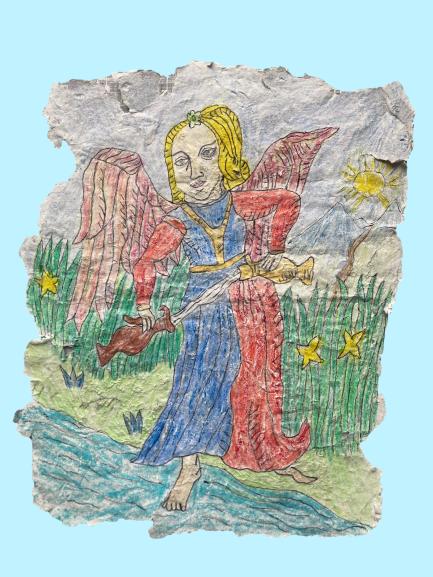
I keep thinking about Temperance. The angel who walks with two cups in hand mixing and sloshing water from one cup to the other. Searching for the right mix, they seem caught in a moment, between states. This image always makes me think of trusting the path you are on, a state of becoming, a search for harmony.

~

Temperance’ by Jack O’Flynn. pencil and pen on handmade paper by Connie Hurley 2020.

Perhaps I have been drawn to Yin this summer as I’m a little uncertain of what’s ahead, and like the mountains in the distance, what’s behind feels far away. Like the angel in Temperance I find myself in a middle ground, an Edge space. Sometimes this angel can be seen as hesitant, a little unsure of where to go; so it just neurotically mixes the water back and forth, not knowing whether to take a step into the water or back onto the land. 

Energetic body

The practice of Yin has its roots in traditional postural Hatha Yoga as well as well as the Taoist philosophy of Chinese Medicine. According to this philosophy, the body can be understood as hundreds of energy points called Meridian lines. These energy lines are responsible for moving Chi throughout the body, Chi can be translated to something like, ‘Life Force’; the force that animates our life and body.

Our ‘Life force’ will from time to time, become blocked. Restlessness, fatigue, depression, anxiety, and all other de-stabilizing stagnations within the body will stop the healthy flow of energy. Like the water of Temperance, our water is held between two poles, held still, it will eventually thicken, cluster, and clog, needing to be shifted. This feels like a perfectly normal thing, our bodies and life are fluid, we are changeable, and not meant to be in one state forever.

~

As Temperance moves they keep the water moving from one cup to the next, two feet between two states. They are in a state of flux, they hold their water, their life force, and wait for the right moment.

Yin is a watery practice. Becoming like water we release, and connect to our body’s water-like intelligence. As water moves through cracks in rock, we move through the density of our flesh, bones, and cartilage in passive patience.

Like the tides, lakes, or oceans, our watery body is a place of residue, of collection. In the crevices and corners of the unseen, we store memory: as Bessel Van der Kolk has said, The body keeps the score.

Being at the Edge is about moving toward the still, murky waters of life. Where we move toward the scores, and rhythms of affect that have washed up, fragmented, and dispersed through the lakes and tides of the body.

~

My time of Yin this summer has allowed me to sink into uncertainty, to not look for a way forward, but to enter into the residue, the unclear density. Sometimes before we move forward we must first acknowledge the confusion of where we find ourselves. In becoming there is a loss at what has come before. And before we can move into a new realm with clear sight, sometimes we have to take stock of what has been gathered.

One definition of Temperance is moderation. As the water is mixed slowly and with care: the right formula is searched for, the correct temperature. When the right conditions arrive water changes, stagnation is released, and new rivers open into wide expanses of sea.

As we hold at the Edge of our bodies, we are at the edge of the Self, of becoming; shifting toward a self that is unseen, authentic, and beckoning.

~~~~~~~~~~~~~~~~~~~~~~~~~~~~~~~~~~~~~~~~~~~~~~~~~~

Artwork and text created by Jack O’Flynn. 2022.

Sources:

Yin Yoga: Stretch the mindful way. K. Reinhardt.

The Body Keeps the Score Bessel Van der Kolk.

Yoga with Kassandra (Youtube Channel)

Inna Costantini, online Yin Yoga teacher https://www.innayoga.com

The Wheel of Fortune

When we see you 

We spiral

A goblin wheel spins on a dark blue sea.

~

To be surprised, to be stuck, to repeat.

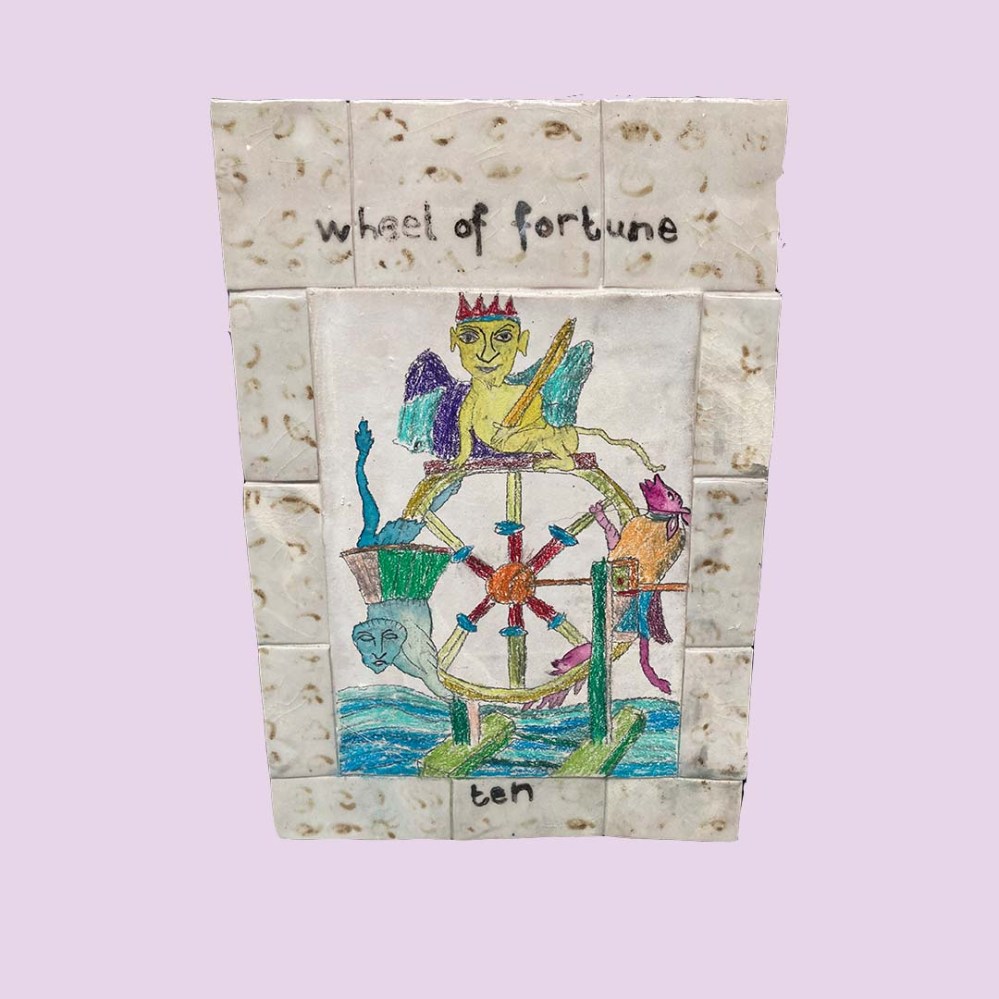
A yellow wheel turns on a blue sea. On its spokes are three mischievous goblin-like creatures and animals. They are falling, climbing, and sitting, each at different places.

The wheel is called ‘The Wheel of Fortune.’ Who are these creatures, and what is this strange wheel?

A wheel is a circle of spokes that turns and spins, often connected to an axel, which is then connected to a larger machine.

The movement of the wheel controls the movement of the larger machine; 

So a wheel is a point that decides direction.

Fortune speaks of the chance, luck, or money we might receive in life. Fortune may be good or bad, bringing us up or down.

To speak of someone’s fortune is to speak of that which we receive.

So the Wheel of Fortune could decide the direction of what we receive from life; 

The direction, and destination of our fortune, both good and bad.

~

The wheel of fortune has six spokes that reach outward from a revolving orange center. Its spokes create an order to its movement. Like a strange clock, this wheel has a machine like logic.

But there are no measuring instruments that we can recognize here – there are no numbers or letters. And the spokes appear in not perfectly even rows.

It spins on a blue sea, in water, in slippage; our conscious vision and calculations may not be reliable here.

The ocean is where our life began and where the oldest life forms exist;

in mysterious and dark depths this wheel spins.

Depth; the depth of the world, and the depth of psyche.

The wheel turns beneath what we can see.

~

‘The Wheel of Fortune II’ by Jack O’Flynn and Lisa Rytterund, pencil on glazed ceramic cards, 2022.

~

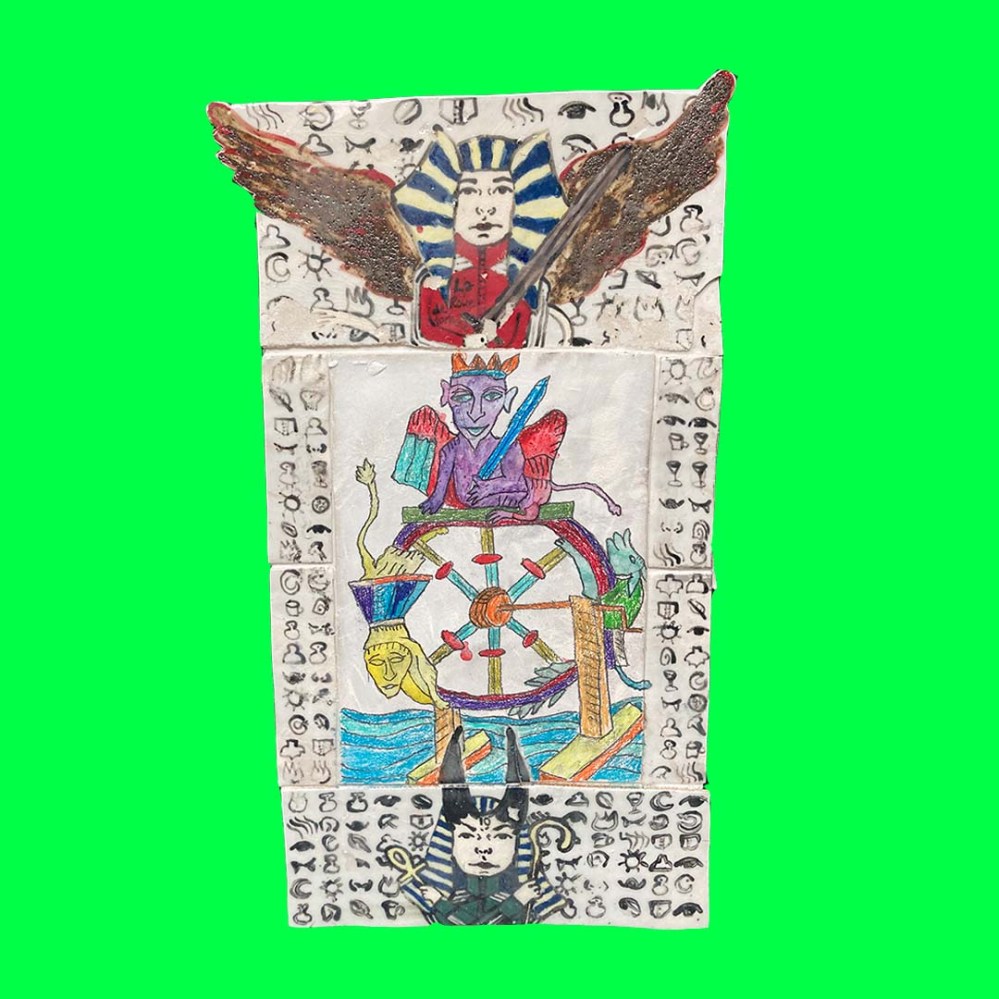
There are three creatures on the wheel. They are at different stages, one is climbing, another is descending and a proud-looking sphynx like goblin sits atop the wheel with a sword in hand.

The creatures pull and claw at the wheel, are they hanging on for life or are they trying to clamber to the top? Maybe they are the ones who move the wheel.

But the wheel is connected to a lever, which leaves the picture. Something outside of their control is in charge of this wheel.

The way to make God laugh is to tell him your plans. The Wheel shares in God’s sadistic pleasure of seeing people disappointed, let down and tormented by life’s cruel twists and turns.

We have ideas, plans, and dreams for our movement forward in life.

The Wheel reminds us we are never fully in control of our movement, in fact, we may be controlled and at the mercy of a cruel and twisted machine, one run by goblins and steered by an invisible hand.

~

‘The Wheel of Fortune III’ by Jack O’Flynn and Lisa Rytterund, pencil on glazed ceramic cards, 2022.

~

The blue goblin on the top of the wheel sits, seeming to look on at us with a smirk. They have a sword in hand, a crown, and a cape. They appear to have acquired something on this wheel.

Looking closely, they have a small platform to sit on, They are on the wheel, but they are not fully attached to the wheel like the others.

To recognize that we are not fully in control of how our life spins, and to accept the ups and downs of life with a smirk – may be a profound accomplishment in this spinning vortex.

~

Planets, stars, and galaxies are pulled apart and spun around each other by mysterious forces;

To be on this planet in one way or another is to be along for the drive. We do our best to move forward and make choices. But like a clock that moves with thousands of levers and parts; there are variables and mechanics in life that are out of control.

There are events that will happen to us, people who will change us, and roads closed off to us.

The Wheel cautions: you are not in control and beneath the veil of your actions there may be a spinning indifferent wheel of maniacal goblins.

But perhaps it also says – don’t take this too seriously. In the words of Bill Hicks:

‘It’s just a ride’.

~~~~~~~~~~~~~~~~~~~~~~~~~~~~~~~~~~~~~~~~~~~~~

~~~~~~~~~~~~~~~~~~~~~~~~~~~~~~~~~~~~~~~~~~~~~

~~~~~~~~~~~~~~~~~~~~~~~~~~~~~~~~~~~~~~~~~~~~~

~~~~~~~~~~~~~~~~~~~~~~~~~~~~~~~~~~~~~~~~~~~~~

~~~~~~~~~~~~~~~~~~~~~~~~~~~~~~~~~~~~~~~~~~~~~

Artwork for this post was created by Jack O’Flynn and collaborator Lisa Rytterlund in Bergen, Norway.

Lisa Rytterlund is a Swedish artist currently based in Bergen, Norway. Primarily working with clay and ceramic processes, they currently create work that explores self-portraiture along with mythical and religious symbolism, through an often playful approach and humourous lense.

Find Lisa’s work here https://www.instagram.com/rytterlund/

~

Jack O’Flynn 2022

The World

When we see you

We are protected

By a bird and an angel, a lion and a bull

~

To be whole, to be complete, to be realised

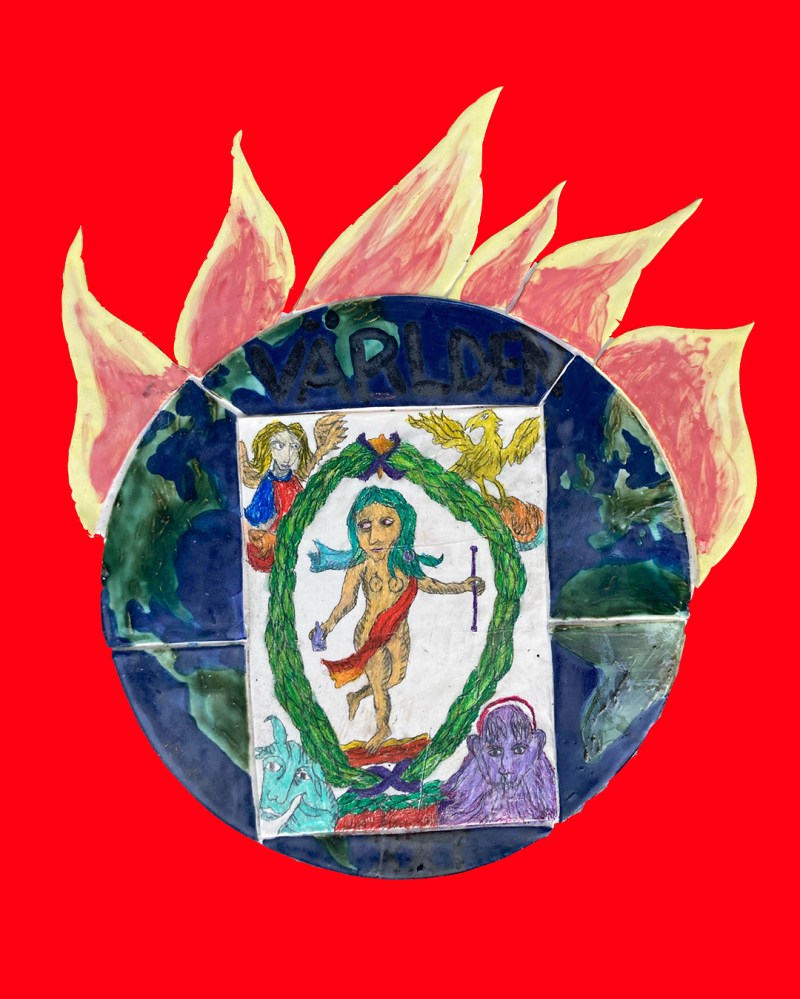
A woman hovers in a bounded blue garland. One foot raised and crossed behind the other, she holds a cup and wand in her hands, as a cloth floats across her body.

If the Fools journey begins with a step into the unknown, It finishes at The World. The final card of the Major Arcana of the Tarot .

When we speak of The World, we usually speak of the Earth, our planet, with its landscapes, ecology, countries, atmosphere, wildlife, and people.

The World is where we live; it contains and sustains our existence.

To speak of someone or something’s ‘World’ is to speak of that which holds all that there is to say about them.

Our World defines us.

It is something all-encompassing, a holder of diversity, and a finality.

Why does Fool end their journey here at The World? What does the floating woman encased in a blue garland have to tell us?

~

‘Le Monde II’ by Jack O’Flynn and Lisa Rytterund, pencil on glazed ceramic cards, 2022.

~

In her hands she holds a wand and cup. A wand is for creating and moving out into the world, a cup receives and holds, bonds, and pours.

Life is a continual process of outward to inward,

expansion to retraction, inhale to exhale.

To hold these energies seems to say:

You hold the forces of life in your hand,

you are a self-creating force.

a self-sustaining vessel.

~

She stands freely, proudly, and calmly. This calm stance has been earned, through the trials of becoming, loss, renewal, and emptying.

When we reach the World, we may stand, softly, yet firmly in our place. 

When you arrive at your place, your World; there is an ease, a softening into the body.

To stand freely, with softness and security,  you have to trust in the safety of your place in the World. To be safe, valued, and protected, we must feel of Worth.

Worth, could be considered one of the final destinations of our journey through these cards. How to find it, how to believe it, and how to sustain it.

Self-Worth.

Worthy of attention, Worthy of protection 

The World says we are Worthy, because we are it and we are here.

~

‘Le Monde III’ by Jack O’Flynn and Lisa Rytterund, pencil on glazed ceramic cards, 2022.

~

Standing freely in a container of garlanded leaves, they are enmeshed and flowing, pulsing with energy. They create an orb of serenity and clarity. This portal is bound tightly, it is safe and solid and forms an opening in the middle of the card. 

Worth when discovered, binds us, and keeps us safe, allowing us to venture into new realms, secure within our orb of Worth. 

An angel, a bull, a bird, and a lion secure in place the garland which protects the woman. They are elemental guardians, supporting and holding the World together, above and below.

This is a harmonious structure, each element has its place, protecting the floating egg.

She is naked, but for a cloth floating over her body. She does not fear being seen, but rather in the last analysis there is always something that can’t be fully revealed; creation and the self is, a mystery.

The cloth of protection hangs gently, suspended in a perfect moment. Her foot grasps the floor and she holds all that she needs to. 

The gentle draping of the cloth reminds us that life is fleeting; it will pass in a moment, this cloth of life needs to be felt, and cared for, for it is all that we have. 

The World, caught in a tender orb,

hangs in the balance. 

It is precious, and must be protected.

~~~~~~~~~~~~~~~~~~~~~~~~~~~~~~~~~~

~~~~~~~~~~~~~~~~~~~~~~~~~~~~~~~~

~~~~~~~~~~~~~~~~~~~~~~~~~~~~~~~~~~~

Artwork for this post was created by Jack O’Flynn and collaborator Lisa Rytterlund in Bergen, Norway.

Lisa Rytterlund is a Swedish artist currently based in Bergen, Norway. Primarily working with clay and ceramic processes, they currently create work that explores self-portraiture along with mythical and religious symbolism, through an often playful approach and humourous lense.

Find Lisa’s work here https://www.instagram.com/rytterlund/

Jack O’Flynn 2022

Death

   ~

When we see you

We pass

To the black soil of purple hands

~

To disintegrate, to churn, to sprout

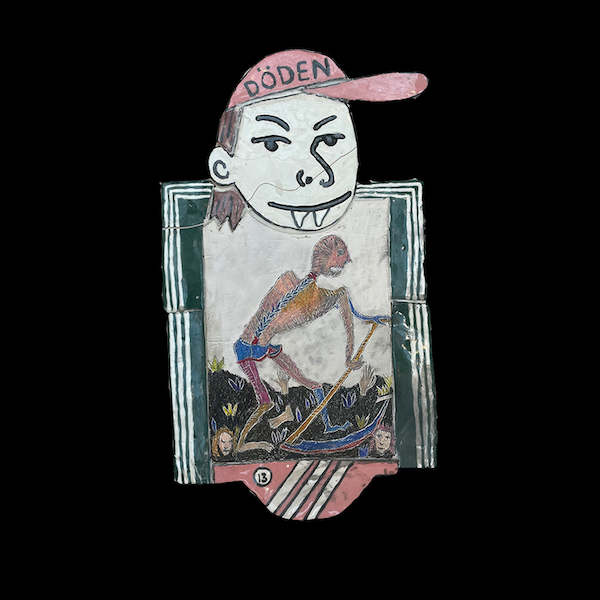
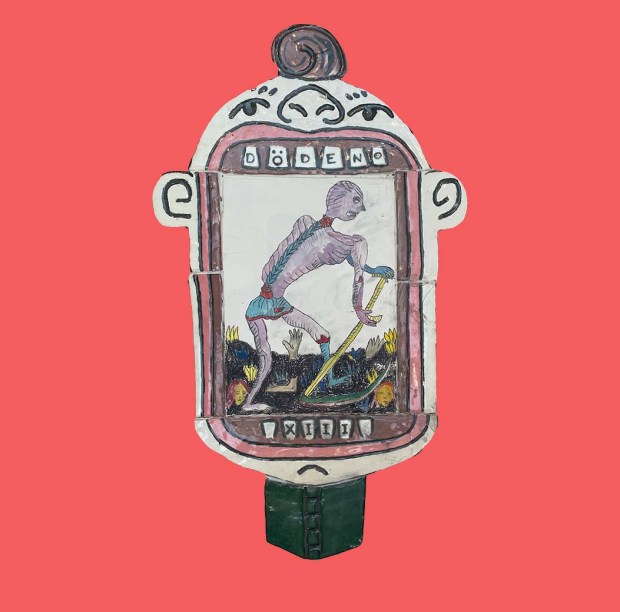
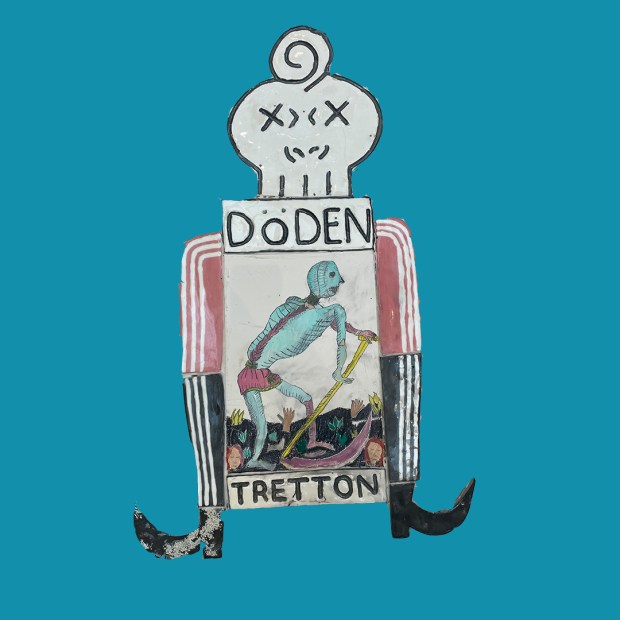
A flesh and blue coloured skeleton scrapes a blade across the black ground. Feet, hands, bones and severed heads are left in its wake. From the black soil tufts of purple and yellow grass sprout up. 

Death in most definitions is considered an end. For something to meet its Death, is to be destroyed, finished; annihilated

But I want to consider Death,  and the nameless or 13th Arcanum of the Tarot, as a process of change, a process that speaks to transformation: through cutting, decomposition, rot and re-generation.

There is a saying in Ireland that when someone dies they have ‘passed on’

To pass is to move from place;  Passing could signify the movement of time, the movement of water in a river or the eating and digesting of food. For someone to ‘Pass On’ is for someone to move somewhere, to change into something, to become something else.

What happens to a body that has ‘passed on?’

The process of Death begins when our physical bodies, no longer enlivened by oxygen, begin to discolour and stiffen. The ‘stench of Death’ of putrefaction begins with a release of microorganisms and bacteria that commence decomposition. The body bloats; organs, skin, tissue and muscles liquify;  

After around a month of intense changes to our physical body, our teeth, cartilage and hair are left to sink into the ground.

The breakdown of tissue leaves only skeleton remains, to become fossilized, or broken down too: becoming brittle, cracking, disintegrating and returning to dust.

Seeing the skeleton walk across the black ground in some way reminds us of this process, this horror that feels so alien to our live, warm, and fluid bodies. We crave our lives to be solidified and secure.

But our bodies are in a state of ongoing flux. Each day we are shedding skin and hair, processing food; excreting sweat, fluid, shit, and bacteria. These are all parts of ourselves, parts that are, Passing, from one place to another, each moment.

When we inhale we breathe in Oxygen, when we exhale we release chemicals no longer needed back to the world – emptying our lungs. In this process of gas exchange, our inhales and exhales keep our organs, blood vessels, and tissues churning. Air opens up and closes our bodies – allowing new life to come and go.

If inhalation is the breath of life, then exhalation may be the breath of Death.

With each exhale; each excretion of waste from the body, we become Death: becoming decay, revolution, movement.

~

‘DÖDEN’ By Lise Rytterlund and Jack O’Flynn. Glazed ceramic, pencil, pen, wood. 2022

Hospitals, sewers, dumps, wastelands, and all places where sickness, rot, and decay have been cast to, remind us of Death. We reject them, are revolted by them, and prefer to keep them away, cordoned off, underground, shipped away. To make contact with them is to make contact with Death.

Julia Kristova, spoke about the revolting power of Death, decay and waste as the abject; That which is truly not us, that which the ego does not recognize. 

“These body fluids, this defilement, this shit are what life withstands, hardly and with difficulty, on the part of death. There, I am at the border of my condition as a living being.” 

We keep Death at ‘the border’, to live as though it were not a part of us. To keep out of mind the fear and revolt it brings us. But there is power at the border of the abject. Our ego, our sense of self, finds itself strengthened in its rejection, knowing what it is not, what it refuses.

~

‘DÖDEN 2’ By Lise Rytterlund and Jack O’Flynn. Glazed ceramic, pencil, pen, wood. 2022

The skeleton walker of the Death card walks with a long blade in hand, powerfully, dynamically stepping forward. With each step they take, a new layer of skin is grown.

As the purple and yellow growths sprout from the black soil, the body, re- generates, our psyches too become re-born.

In his book Dream and the Underworld James Hillman speaks about dreams as a place of Death. In sleep each night our collected psychic material goes to be churned, cut-up and re-fed to us in dramatic, surreal situations.

Figures from our past come to us with messages, in sometimes profound or equally absurd vignettes. In the dissolve of dream location our self and body slips from places; through feelings, thoughts and memories. Our dayworld intentions are harder to locate.

 If Dreams are a Death space for the residue fibre of our lives, a place where our muscle memory is sent to be worked up and processed, then the matter they condense into is black soil.

Rich black soil of carbon and compost; a fertile humus that Death walks upon, feeds, turns and reaps with the scythe. Each lost body part, each shed identity, each forgotten dream has gone under the sharp blade of Death.

To sleep and dream is to sink into the black soil.

The black soil of soul making.

~~~~~~~~~~~~~~~~~~~~~~~~~~~~~~~~~~~~~~~~~~~~~~~~~~~

~~~~~~~~~~~~~~~~~~~~~~~~~~~~~~~~~~~~~~~~~~~~~~~~~~~~~~

~~~~~~~~~~~~~~~~~~~~~~~~~~~~~~~~~~~~~~~~~~~~~~~~~~~~~~~~

Artwork for this post was created by Jack O’Flynn and collaborator Lisa Rytterlund in Bergen, Norway.

Lisa Rytterlund is a Swedish artist currently based in Bergen, Norway. Primarily working with clay and ceramic processes, they currently create work that explores self-portraiture along with mythical and religious symbolism, through an often playful approach and humourous lense.

Find Lisa’s work here https://www.instagram.com/rytterlund/

~~~~~~~~~~~~~~~~~~~~~~~~~~~~~~~~~~~~~~

Sources

The Dream and the Underworld, Hillman. J 1979

Powers of Horror, Kristeva. J 1980

~

Jack O’Flynn 2022

The Tower

When we see you

We are shaken

Trembling on a ground of waves

~

to upset, to reveal, to liberate

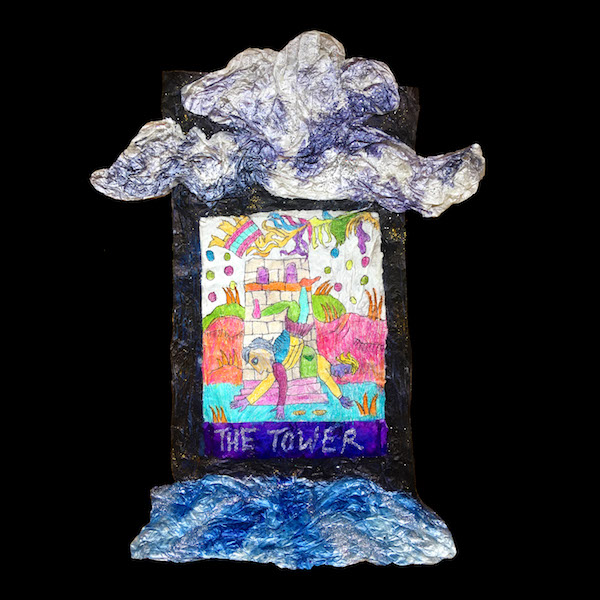
A cascading Tower looms tall. A lightning bolt cracks a hole through the sky. The crowned roof comes falling off. A man dances on his hands.

The Tower is perhaps the most feared card in the tarot. Ideas of ruin, devastation and crisis have long been attributed to the sight of the trembling tower walls, striking fear into those who see it.

And true, the Tower may bring these fears, but that’s not all that it offers.

To understand this card we have to first understand what a Tower is.

A Tower is a construction; It protects and fortifies from the outside world, keeping those inside safe. It may hold a reservoir of accumulated goods and knowledge, as well as serving as a vantage point to threats;

A Tower is a construction from which we can see. 

Our lives are made of many constructions. Within the walls of our experience is a story about who we are, where we are from and what has happened to us. This accumulated store of energy becomes a tower; a way of being, a structure that keeps us safe, contained and fortified.

We need structures, like we need walls to a house. Walls and structures help us to define who we are and make sense of the world.

~

But what happens when the structure that we are familiar and safe in, is suddenly changed?  

The sudden crash of lightning and the falling roof of the Tower can be seen as a dramatic, unforeseen event that shakes the foundation of the way things normally are. This strike could look like a revelation of truth, or a sudden upheaval that upends our perspective.

~

‘The Tower II’ by Jack O’Flynn and Tamara Macarthur, pencil, pen, paint, glitter, paper mache. 2021

~

After this strike, we cannot go back to the way things have been.

And perhaps this is why the Tower is so feared as a card

because of change.

Humans fear change, especially to the structured ways we have learned to live. Change is the unknown, it’s the potential for failure, and the loss of what was.

But change is inevitable, and constant.

Shunryu Suzuki, the beloved Buddhist teacher, was once asked what the most important teaching of Buddhism was, he replied ‘everything changes’

The change that the tower brings may come about through crisis and moments of stark exposure, but some times we need these sudden shocks to wake us up to the reality of our lives.

And crisis, sudden change and loss may also bring some unexpected gifts.

~

There is a central figure who seems to be falling through the sky, plummeting from the Tower walls. I had always seen their dangling legs and outstretched arms as crying for help, as they fall to their death.

But on closer inspection, I could not say that they were really falling; their hands seem to touch the floor, and they have a peaceful look on their face.

What if instead of falling, they have escaped from the Tower’s door and are now jumping onto their hands, kicking their feet into the air with joy?

The Sufi poet Rumi wrote that the door to love was devastation, and that allowing ourselves to fall would one day give us the wings to fly.

Perhaps he was signalling the potential for devastation to open up the emotional landscape. As devastation takes hold, and claims our past we may feel a new connection to the world around us, one no longer governed and confined by old walls and structures.

There may be sorrow and mourning at the loss of what was, but allowing ourselves to release when crisis appears, as the jumping man seems to do, may eventually lead to a new liberation.

~

From the moment of crisis to the liberation of destruction we eventually find one of my favourite keywords for the Tower: reconstruction.

Carl Jung put it simply, ‘Nothing can be created without something first being destroyed’ 

The spark of the Towers’ flames may become a light that illuminates, showing us what we need to change and where.

But the walls will eventually be re-built. However this will not be a simple reconstruction, it points to a more deeper restructuring. One that goes down to the foundations, to the roots.

Seeing the Tower can be to see a problem in your life in all of its totality leading you to completely rethink and revise your perspective on it.

~

‘The Tower III’ by Jack O’Flynn and Tamara Macarthur, pencil, pen, paint, glitter, paper mache. 2021

~

The Tower clears the way for new foundations to be laid, and with new foundations,

we can build new constructions, with new vantage points;

new Towers to see from.

until the shaking of the Tower walls begins again

and a lightning strike brings our Tower

crashing down

like a trembling wave.

~~~~~~~~~~~~~~~~~~~~~~~~~~~~~~~~~~~~~~~~~~~~~~~~~~~~~~~~~~~~~~~~~~~~~~~~~~~~~~~~~~~~~~~~~~~~~~~~~~~~~~~~~~~~~~~~~~~~~~~~~~~~~~~~~~~~~~~~~~~~~~~~~~~~~~~~~~~~~~~~~~~~~~~~~~~~~~~~~~~~~~~~~~~~~~~~~~~~~~~~~~~~~~~~~~~~~~~~~~~~~~~~~~~~~~~~~~~~~~~~~~~~~~~~~~~~~~~~~~~~~~~~~~~~~~~~~~~~~~~~~~~~~~~~~~~~~~~~~~~~~~~~~~~~~~~~~~~~~~~~~~~~~~~~~~~~~~~~~~~~~~~~~~~~~~~~~~~~~~~~~~~~~~~~~~~~~~~~~~~~~~~~~~~~~~~~~~~~~~~~~~~~~~~~~~~~~~~~~~~~~~~~~~~~~~~~~~~~~~~~~~~~~~~~~~~~~~~~~~~~~~~~~~~~~~~~~~~~~~~~~~~~~~~~~~

The way of love is not
a subtle argument.

The door there
is devastation.

Birds make great sky-circles
of their freedom.
How do they learn it?

They fall, and falling,
they’re given wings.

Rumi, The way of Love

~~~~~~~~~~~~~~~~~~~~~~~~~~~~~~~~~~~~~~~~~~~~~~~~~~~~~~~~~~~~~~~~~

Artwork for this month’s When We See You comes from a collaboration between artist’s Jack O’Flynn and Tamara Macarthur. Tamara created the cards from paper mache, paint, gold and glitter, leaving space in the middle for Jack to re-create the tarot image with colouring pencils and pen. The image in the middle was re-imagined from the Tarot de Marseille ‘La Maison Devx’ (The Tower) card.

Tamara Macarthur is a Glasgow based performance artist whose work explores tears, longing and intimacy within the space of theatrical, glittering sets of cathedrals, trees, waves and stars. See more of Tamara’s work on her website below.

https://cargocollective.com/tamaramacarthur